
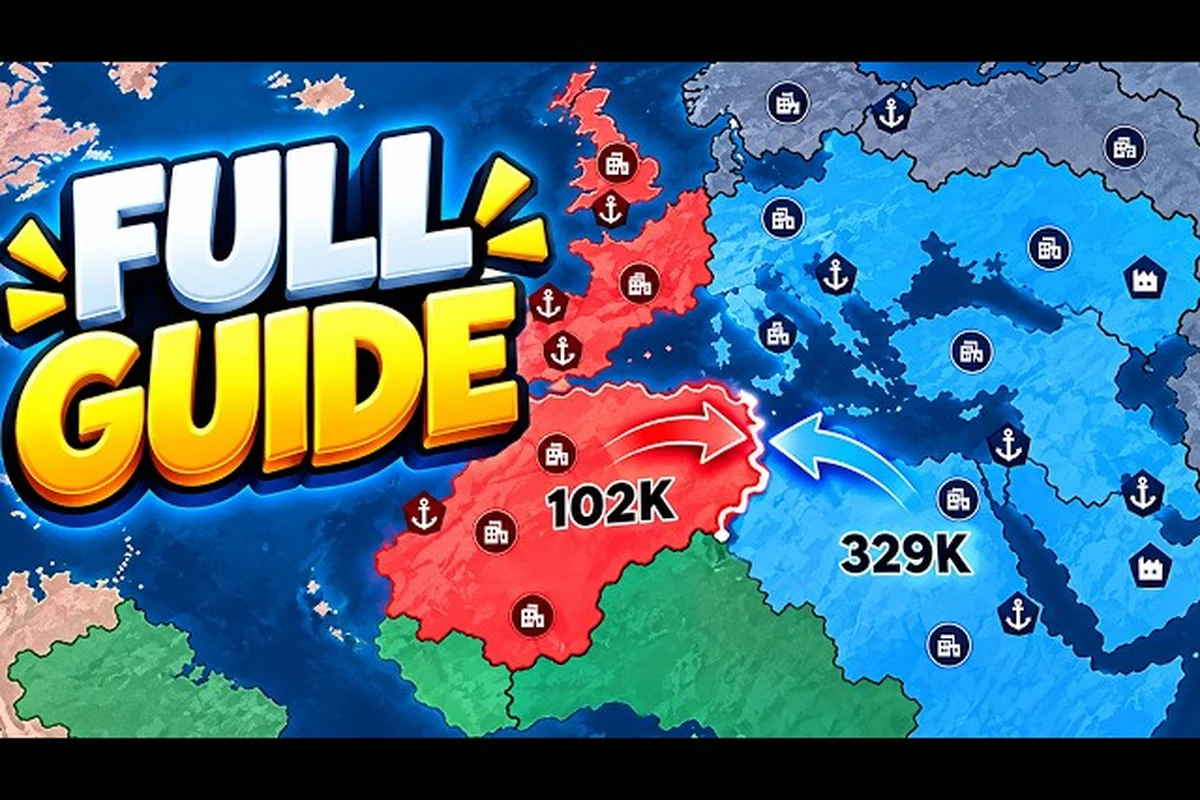
War in RoWorld often begins with a reasonable security decision: accepting help, joining a stronger power, or asking a neighbor to stop expanding near your border. Those choices can secure a nation, but a poorly managed partnership can leave it dependent, exposed, or trapped. Learning how to avoid war means balancing immediate safety with long-term diplomatic control.
Why Avoiding War Matters in RoWorld
RoWorld is a large-scale multiplayer strategy game in which nations, cities, ports, factories, alliances, and nuclear weapons shape a shared world. According to the official RoWorld page on Roblox, a match can feature 88 player nations alongside hundreds of tribes, with victory tied to controlling 80% of the world. That structure makes every border decision consequential: one broken promise can redirect armies, resources, and attention across several regions.
The best way to avoid war is not merely to refuse every alliance. Isolation can be just as dangerous when hostile powers compete for the same space. Instead, successful players build relationships that are useful without being unlimited, preserve a credible independent position, and make every commitment easier to fulfill. That approach turns relationships into a form of strategic insurance.
| Strategic position | Main advantage | Main danger | Best use |
|---|---|---|---|
| Independent player | Maximum freedom of movement | Can face pressure from several directions | Early positioning or cautious expansion |
| Reliable ally | Adds security and useful capacity | Creates dependence | Border protection and shared defense |
| Flexible partner | Offers options without a rigid commitment | May be less dependable | Trade, intelligence, and temporary cooperation |
| Rival | Can discourage expansion through pressure | Offers little trust or stability | Contested borders and last-resort deterrence |
The Real Cost of a Multi-Front War
A military defeat ends more than a battle. Cities and infrastructure can be exposed, troops can be diverted, and builders may have to choose between strengthening the economy and defending threatened borders. In a world with many nations, a second front can become more damaging than the first because attention and resources are already stretched.
A careful roWorld ally selection process therefore examines geography, reliability, and intent before it examines potential benefits. A partner with an excellent position but an unstable record may create exactly the dependency a player hoped to avoid. The strongest relationship is one whose benefits remain useful even when its behavior becomes difficult to predict.
Build a Safer Diplomatic Foundation
Peace depends on making your own intentions legible. Players who suddenly change direction, ask for large support, or act aggressively without explanation create uncertainty. A stable player is easier to trust because others can estimate the next move without demanding constant reassurance.
Start by separating three promises: cooperation, which covers trade or limited coordination; mutual defense, which applies when an ally is attacked; and union, which implies shared strategic control. These commitments carry different levels of exposure. Agreement on the actual purpose prevents a minor promise from becoming an unlimited obligation.
Define the Scope Before Making a Commitment
Written terms are not officially published for every form of agreement in RoWorld, and community reports describe truce systems, alliance chat, and traitor markings in different ways. Rather than assuming every agreement behaves identically, define the scope in plain language: what you will support, what you will not support, how long the arrangement should last, and what action signals that it has ended.
Useful boundary-setting questions include:
-
Will the alliance defend against an attack, or only share information?
-
Does support include troops, resources, construction help, or diplomatic backing?
-
Are territorial promises, trade arrangements, and military alliances separate?
-
Which actions count as breaking trust?
-
What happens if one side needs to exit?
This process directly supports roWorld alliance etiquette because clear expectations reduce the chance that either side interprets routine movement as hostile intent.
| Commitment level | What it includes | What it should not imply | Main benefit |
|---|---|---|---|
| Information sharing | Warnings, sightings, and general plans | Automatic military support | Low-risk trust building |
| Trade cooperation | Resource or port-based exchange | Shared war obligations | Better economic efficiency |
| Limited joint defense | Help against a defined attack | Authority over another nation’s territory | Stronger border deterrence |
| Broad alliance | Ongoing strategic coordination | Constant access to every decision | Stronger deterrence with greater risk |
Make Small Tests Before Large Commitments
Diplomacy is easier to evaluate when commitments are gradual. Begin with a small exchange, a limited defense, or a short mutual understanding, then observe whether the partner communicates honestly and respects borders. A successful first test gives both sides a reason to continue without turning one mistake into a catastrophic break.
Player experience reported in community videos suggests that early communication often works best when it remains practical. Share concrete information, state which border is exposed, and avoid vague promises that can be reinterpreted later. If the larger RoWorld alliance strategy overview covers broader alliance formation, this guide focuses on the restraint required to keep such arrangements peaceful.
Evaluate roWorld Ally Selection by Risk
Ally selection is a risk assessment disguised as a social decision. Geography, recent behavior, shared enemies, and the ability to honor promises all affect whether a relationship will protect or endanger your nation. The largest immediate threat may deserve an alliance, but the safest partner is not automatically the strongest one.
A reliable ally should have a reason to respect the arrangement. Shared borders, trade, common enemies, and dependence on mutual survival can all provide that reason. By contrast, a partner who gains more from your weakness than from your strength may accept an alliance for access, resources, or territory without caring whether the relationship lasts.
Score Each Candidate Qualitatively
Use observable evidence rather than personality impressions. A promise repeated in chat matters less than a history of keeping borders, reacting reasonably to setbacks, and avoiding unnecessary escalation. Since RoWorld does not publish formal reputation values, this assessment should remain a player judgment rather than a claimed game statistic.
| Candidate profile | Likely reliability | Strategic value | Primary risk | Better approach |
|---|---|---|---|---|
| Neighbor with a defended border | Medium to high | Immediate protection | Border pressure | Negotiate limits before expanding |
| Distant nation with a shared enemy | High when interests align | Deterrence and support | Limited ability to respond | Keep a written non-aggression understanding |
| Powerful regional leader | Variable | Access to influence and resources | Loss of autonomy | Accept support narrowly, not blank checks |
| New or unproven player | Unknown | Future potential | Broken promises or instability | Test the relationship incrementally |
| Former ally with a betrayal history | Low | None beyond immediate geography | Repetition of the same pattern | End the relationship carefully or prepare defensively |
Watch the Direction of Benefit
An agreement is safer when both sides can explain what they receive. A partner that only offers protection while expecting unlimited access to your cities or decisions may be seeking control rather than cooperation. Clarify whether support is reciprocal, and do not assume that shared opposition to another nation automatically means shared interests in every later dispute.
This is where roWorld alliance benefits should be evaluated honestly. Immediate military assistance can be valuable, but information, trade access, deterrence, and freedom to choose another partner may matter more over a full match. Benefits that require constant supervision are usually less valuable than modest benefits that remain stable.
Prevent Misunderstandings with roWorld Alliance Etiquette
Most avoidable conflicts begin as ambiguous signals rather than deliberate declarations of war. A unit enters the wrong region, a trade route changes, a port becomes essential, or one side responds to a threat in a way the other interprets as an attack. Consistent etiquette reduces that uncertainty by establishing predictable behavior.
Good etiquette starts with restraint. Avoid gathering a large force beside an ally’s border without a reason, because the visual alone may look like preparation for invasion. If a movement is necessary, communicate the purpose and expected duration. Likewise, do not recruit a new military partner while an existing arrangement is still active unless you have disclosed the change and clarified the effect on old promises.
Use a Simple Communication Pattern
A concise message can prevent a large misunderstanding. State the action, the reason, the area involved, and the expected end point. If a reaction may alarm the other side, send the message before moving rather than after. This is practical roWorld alliance etiquette that works even when formal treaty menus are unclear.
-
Identify the intent: Explain whether the movement is defensive, economic, or exploratory.
-
Name the location: Give the general area so the recipient can distinguish the action from a border threat.
-
Set an endpoint: State when the force will withdraw or when the situation will be considered resolved.
-
Confirm the response: If the plan changes, update the other side instead of assuming old consent still applies.
| Common ambiguity | Safer interpretation | Diplomatic action | Conflict risk |
|---|---|---|---|
| Troops appear near a border | Possible defensive buildup | Ask about purpose and endpoint | Medium |
| A trade route expands | Economic development | Confirm the route and shared access | Medium |
| A new ally appears | Shift in regional balance | Clarify how existing promises change | Medium to high |
| Minor border contact | Accidental movement | Acknowledge and correct promptly | Low if handled well |
| Sudden mobilization | Uncertain preparation | Pause and seek clarification | High |
Handle a Rupture Without Escalating Further
A disagreement can become irreversible when every response is interpreted as the next step in a war. The best response to a broken promise is controlled: preserve evidence of what happened, stop making new commitments, and separate the practical dispute from insults or threats. Emotional escalation gives a potential opponent a reason to unite against you.
If a partner breaks an agreement, consider what can still be salvaged. Sometimes a military alliance was intended to be temporary. Sometimes the misunderstanding is narrower than it first appears. A direct, factual message can reopen negotiations without pretending the violation had no effect.
Use a Graduated Response to a Broken Promise
First, verify the facts. Compare chat logs, visible actions, and the original terms. A rumor can trigger a much larger conflict than the underlying disagreement. Second, state the impact. Explain which commitment was broken and what boundary was crossed. Third, offer a narrow path forward. Return to limited cooperation, relocate activity, or negotiate a formal separation.
Fourth, prepare a defensive plan. Diplomacy should never replace basic security. Protect vulnerable cities, avoid overextending your borders, and keep a route open to disengage. Fifth, record the behavior. A former ally who ignored one warning is more likely to repeat the pattern, so future negotiations should require more evidence before granting trust.
Know When to End an Alliance
Some relationships are not worth repairing. Ending an unproductive agreement can be safer than maintaining a vague partnership that leaves both sides guessing. When a partner repeatedly crosses borders, spreads false information, recruits against you, or treats a refusal as permission to attack, separation becomes a defensive act rather than a betrayal.
Understanding roWorld how to break an alliance is useful even for cautious players because exit plans should be considered before the relationship deteriorates. The process should reduce immediate danger, preserve useful assets, and make the reason clear. Community reports mention a traitor mark after a break, but its exact behavior and duration are not published as an official rule, so players should treat it as reported information rather than a guaranteed penalty.
| Situation | Recommended response | Avoid | Diplomatic objective |
|---|---|---|---|
| One accidental violation | Clarify and correct | Immediate retaliation | Restore trust quickly |
| Repeated minor breaches | Narrow the relationship | More open-ended promises | Limit future exposure |
| Major breach of trust | Separate responsibilities | Pretending nothing happened | Prevent further losses |
| Clear hostile intent | Prepare defensively and disengage | Lengthy public arguments | Preserve territory and resources |
| Mutual disagreement | Renegotiate narrowly | Expanding demands indefinitely | Restore a stable working relationship |
Build a Sustainable Peace Strategy
Peace is not a single treaty that remains valid for the entire match. Borders change, alliances shift, and new powers emerge. A sustainable strategy creates layers of protection: economic strength, friendly relationships, credible defense, diplomatic credibility, and the ability to limit damage when one layer fails.
The RoWorld guide to avoiding elimination is useful for protecting a nation from broader strategic pressure, while this article’s focus remains on preventing avoidable conflict. The most resilient player is not the one who wins every negotiation; it is the one whose plans still work if an ally leaves, attacks, or changes priorities.
Use a Conflict-Prevention Routine
Review diplomacy whenever your strategic position changes rather than waiting for a crisis. A short routine can reveal commitments that no longer fit, including defense requests, shared enemies, trade assumptions, and promised non-aggression. Keep a plain record of agreements, the people involved, and the actions that would constitute a violation.
| Planning phase | Diplomatic priority | Concrete action | Result |
|---|---|---|---|
| Early expansion | Reduce border uncertainty | Communicate intended routes | Fewer accidental clashes |
| Regional growth | Manage competing interests | Clarify trade and territory | Better ally compatibility |
| Major power shift | Reassess old commitments | Renegotiate or separate | Less dependency |
| Under pressure | Prevent multiple fronts | Prioritize one defensive partner | Easier resource allocation |
| Late game | Avoid opportunistic attacks | Secure borders and reinforce trust | Greater strategic freedom |
Balance Cooperation With Independent Value
An alliance is more credible when you remain useful and difficult to dominate. Maintain a functioning economy, protect key cities, and avoid handing over every strategic decision to a larger partner. If you cannot survive without an ally’s approval, your position becomes fragile even if the alliance is currently peaceful.
This principle also explains the value of good internal infrastructure. The RoWorld building and economy guide can help players create a base that supports diplomacy rather than depending on constant emergency support. Strong cities and ports also make trade arrangements more credible because neither side has to carry all of the operational burden.
A good final position looks like this: one or two relationships that are explicit, useful, and regularly reviewed; a truce posture with uncertain neighbors; a defensive plan for border trouble; and enough economic independence that no single ally can dictate every decision. That structure is the practical answer to how to avoid war in RoWorld without surrendering the benefits of cooperation.
Frequently Asked Questions
Can avoiding all alliances make a nation safer in RoWorld?
Not necessarily. Isolation can leave you exposed when stronger neighbors compete for nearby land. A limited alliance with a reliable partner may provide useful deterrence, especially near a vulnerable border. The safer approach is to keep cooperation narrow, communicate expectations, and preserve enough independent strength that your nation is not completely dependent on the agreement.
What is the safest way to choose an ally in RoWorld?
Choose based on observable behavior, geography, and aligned interests rather than power alone. Look for a partner with a reason to respect your borders, a shared enemy, or mutual economic needs. Test the relationship with a limited commitment first. If one side ignores boundaries or misuses trust, reduce the agreement before a serious crisis makes the decision more expensive.
How do I break an alliance without starting a war?
Break the relationship calmly, state the reason, and stop the commitments that no longer apply. Avoid public accusations, threats, or unnecessary troop movements near the other party’s territory. Prepare defenses in case the response is hostile. Community reports mention a traitor mark, but the official page does not publish its exact behavior, so treat that feature as community-reported information.
Which roWorld alliance benefits matter most in a long match?
The most durable benefits are dependable defense, useful information, economic access, and deterrence that discourages hostile expansion. A large promise of military help is less valuable if it comes with unlimited demands or creates dependency. Evaluate each benefit by whether it protects your nation without transferring too much control to another player.
What should I do if an ally betrays me?
Verify what happened, document the relevant agreement and actions, and separate the broken promise from any new military threat. Stop making additional commitments, defend exposed cities, and contact the other side with a narrow proposal if reconciliation is plausible. If the behavior is clearly hostile, disengage and prepare for defense rather than responding with uncontrolled escalation.