
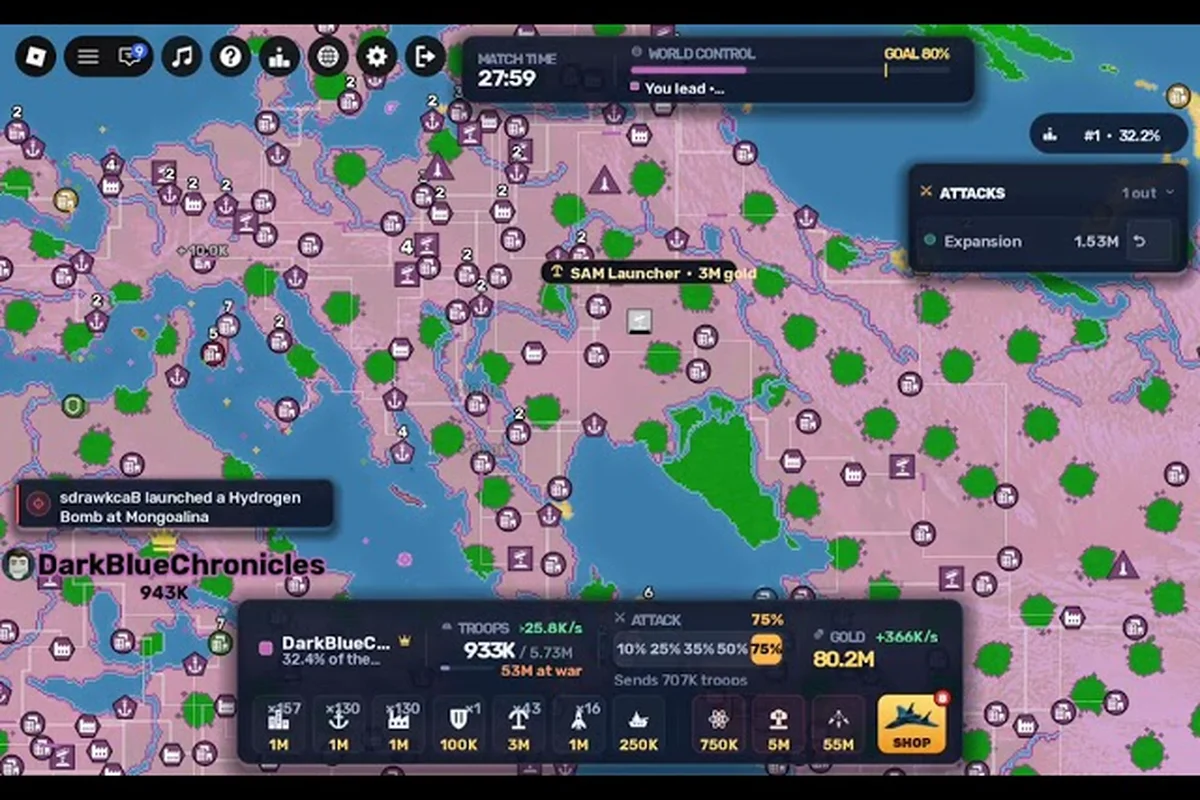
The roWorld late game economy matters because your next victory depends on funding an army without starving production. A practical approach is to compare gold vs troops before each expansion: spend gold when additional territory will generate more income than the troops it displaces, but avoid converting the entire treasury into units. Preserve enough gold to keep construction and recruitment running, then redirect income toward the star arsenal and unlock stars through the available progression. This creates a sustainable snowball rather than a short-lived army surge, helping you gain territory without overextending.
What Makes the roWorld Late Game Economy Different?
Late in a RoWorld match, basic expansion no longer provides the same comfort. Your capital and nearby cities may be surrounded by developed rivals, enemy territory becomes more valuable, and every offensive move can trigger several alliances at once. The official RoWorld game page describes a world containing 88 player nations and hundreds of tribes, with a victory condition based on controlling 80% of the world. That scale means an economy cannot simply be judged by one territory’s output.
The late-game economic problem is a balancing act between three resources with different jobs. Gold supports infrastructure and upkeep, troops create battlefield pressure, and stars unlock powerful late-game options. Spending one category too early can weaken the other two, while hoarding everything protects the treasury but surrenders opportunities.
| Late-game need | Primary economic input | Main benefit | Common mistake |
|---|---|---|---|
| Expand production | Gold | More cities, factories, ports, and connections | Building faster than income can support |
| Defend threatened borders | Troops | Deterrence and a response to attacks | Recruiting armies without a gold reserve |
| Pursue decisive victories | Gold, troops, and stars | Stronger attacks and access to advanced power | Spending stars before the strategy is clear |
Community videos show players choosing a starting nation, claiming land, meeting neighbors, building an economy, and then fighting or negotiating. Those observations support the sequence used here, but they are not official balance rules. The developer has not published exact building costs, income rates, upkeep values, troop multipliers, attack percentages, or star prices, so this guide focuses on decision order and risk management instead of invented numbers.
The three-part economic balance
Gold is the connective resource behind the late game because troops and stars do not remove the need for cities, factories, ports, and support. A larger army can capture territory, but the conquered land must still fit into a workable network. For a deeper look at production and resource flow, the RoWorld gold and resource guide explains how income and spending fit together.
Troops are the immediate instrument of pressure. They threaten borders, protect cities, and support attacks, but a large standing force can consume more gold than expected. Stars represent the most specialized advantage because community players associate them with a late-game arsenal. Their main strategic value is the choice they create: hold them for a major offensive, use them to survive a crisis, or spend them while the opening is favorable.
The strategic sequence that matters
A reliable roWorld economy snowball depends on sequencing gold, troops, and stars rather than maximizing one resource in isolation. A useful benchmark is to measure income against recurring army and territory costs: if gold repeatedly funds disconnected expansions, the apparent wealth is not producing a stronger roWorld star arsenal or sustainable front. For example, maintaining a moderate troop reserve while upgrading connected territory can create steadier gold flow, allowing later star purchases without exposing the economy to a sudden attack.
-
Secure reliable income: improve connected territory and avoid paying for isolated assets that cannot contribute to the network.
-
Create military capacity: recruit enough troops to protect production and discourage opportunistic attacks.
-
Convert advantages into territory: use gold, troops, and stars together when the map and diplomatic situation create a favorable opening.
Skipping straight from expansion to maximum army size is common but dangerous. It can produce a force that appears strong while leaving the economy vulnerable. A reserve matters because attacks can be delayed, intercepted, or countered, and a player must adjust when a front changes before committing every resource.
Gold, Troops, or Stars: Choosing the Right Bottleneck
The most useful roWorld gold vs troops decision depends on the next threat. If opponents are testing your borders, troops may be the immediate bottleneck. If your cities are productive but fragile, a reserve of gold may matter more. If you are already secure and need to break a well-defended position, stars can become the deciding layer.
| Current situation | Better first priority | Why | Keep in reserve |
|---|---|---|---|
| Repeated border probes | Troops | A credible defense discourages further attacks | Gold for maintaining the force |
| Unexplored inland space | Gold | New production creates a stronger base | Troops for protection |
| Strong economy, weak frontline | Troops | Production cannot be captured if it remains defenseless | Stars until a target is clear |
| Secure borders, costly attacks | Stars | Advanced arsenal options can improve offensive power | Gold and troops for recovery |
| Upkeep threatens income | Gold and production | Upkeep must not consume the income supporting it | Troops for emergency defense |
This framework prevents gold vs stars decisions from becoming a fixed build order. Stars are powerful, but spending them without a target creates no coherent advantage. Gold is broadly useful, but tying it up in distant expansion can leave the core weak. Troops solve immediate pressure, but recruitment without a sustainable fund turns a temporary advantage into an expensive commitment.
Why gold remains the foundation
Community players report gold as the main currency for construction and upkeep, while the official page confirms the presence of cities, ports, and factories without specifying their financial values. That distinction matters. It is safe to say that a connected economy can support expansion; it is not safe to claim that a particular building returns a particular amount of gold.
The practical advantage of gold is optionality. It can support new production, replace lost infrastructure, maintain troops, or prepare an attack. When a player commits nearly all gold to one structure, the rest of the plan becomes brittle. A reserve gives the economy time to respond when combat, diplomacy, or geography changes.
For systematic upkeep decisions, the building upkeep and gold priority guide focuses on whether expenses remain sustainable instead of treating income as a static number. In practice, a late-game city or port should be ranked against its ongoing gold upkeep and immediate military value: if a construction project consumes most available gold, troops may lose their funding window, while a star arsenal can provide long-term combat leverage without requiring the same continuous cash reserve. Because roWorld does not publish standardized gold values for every structure, players should compare actual income, city upkeep, and army spending from their own ledger before committing to a major expansion.
When troops are the correct answer
Troops should receive priority when a border is unstable, an ally requests support, or a military buildup indicates an imminent attack. The purpose of those troops is not merely to win one fight. Their broader function is to protect the economic engine so production can continue without repeated disruption.
A practical reserve is a force that can respond to a secondary front. Many defeats occur because an army is tied to one target while enemies open another border. Before committing to a major offensive, check whether nearby rivals are mobilizing, whether the current alliance structure is dependable, and whether the route offers room to protect exposed cities.
When stars deserve consideration
The roWorld star arsenal changes the conversation when basic gold and troop advantages have stalled against a defended objective. Since the game has not published official star costs or effects, compare options qualitatively. A star investment is strongest when it supports a clear operational plan and when the player can still protect the territory around it.
The practical question behind roWorld gold vs stars is simple: does another unit of gold create more immediate value, or does a star unlock an advantage that changes the likely result? If your opponent has a fortified position, superior numbers may still produce a poor exchange. If your home economy is vulnerable, however, saving stars while losing every city would be equally poor.
Building a Sustainable roWorld Economy Snowball
A roWorld economy snowball starts with network quality rather than a dramatic purchase. Connected cities and useful infrastructure can support each other, while scattered assets consume attention and gold. Players should ask whether each new investment strengthens the same production network or creates another obligation elsewhere.
The RoWorld how to build guide is useful for understanding how cities, ports, and factories fit into a broader layout. Late-game placement should support both income and movement, because territory without a dependable connection is difficult to support during a prolonged campaign.
Audit the economic network first
Start with a simple regional review, then compare the likely benefit of each purchase with its gold, upkeep, and opportunity cost. For example, if one border city threatens your star arsenal while another city only delays an enemy advance, prioritize the arsenal route: preserving a reliable source of stars can strengthen your late-game snowball more than adding troops to a distant front. Conversely, gold spent on disconnected land is less valuable when the main fighting zone remains underfunded, so audit the economic network before committing resources.
| Review area | Question to answer | Preferred response |
|---|---|---|
| Core coverage | Which cities support your main fighting zone? | Strengthen the connected core first |
| Border exposure | Which valuable assets can enemies reach? | Add protection where the loss would hurt most |
| Upkeep load | Which expenses are not producing useful pressure or income? | Pause low-value expansion |
| Expansion value | Does new land connect to productive territory? | Favor connected growth |
| Strategic reserve | What remains after planned purchases? | Keep a protected reserve for emergencies |
This review is qualitative because RoWorld does not publish official cost-to-benefit tables. Its value lies in exposing weak links. If several border cities require troops simultaneously, adding one large formation may be less urgent than improving protection where opponents can access your network.
Separate defensive and offensive reserves
A common mistake is treating every troop as part of one disposable army. Defensive troops need to remain near exposed cities and factories, while offensive troops can be positioned near a target. This separation preserves local security even when the main attack becomes delayed or unsuccessful.
The same principle applies to gold. Keep an operational reserve for upkeep and emergencies instead of assuming every coin can join the next offensive. If a major purchase empties the treasury before the operation starts, even a successful capture may not provide enough time to convert the new land into sustainable production.
Attack only when the conversion is clear
A territory gains real value only when it can be connected, supplied, protected, and integrated into the larger economy. In a roWorld late-game snowball, capturing a Star Arsenal or resource-rich settlement is not enough if the new front lacks a secure route for troops, gold, and reinforcement supplies. For example, taking an isolated outpost with a strong gold yield may create a defensive burden: the treasury must continuously fund garrison troops, while enemies can contest the approach without threatening your core settlement. A profitable raid therefore expands the network of connected territory and strengthens the gold-versus-troops balance, rather than merely increasing the number of occupied tiles.
Before an offensive, identify the intended territory conversion path: whether the target becomes a Star Arsenal, a resource-rich settlement, or a protected production node that turns captured ground into recurring gold and star income. For example, a gold-rich outpost is valuable only if its route to the core settlement remains secure; otherwise, its yield is offset by garrison costs and exposes the roWorld economy snowball to repeated attacks. This path should connect the immediate prize to the wider network rather than treating a newly occupied tile as income by itself.
-
Name the production or strategic benefit the target would provide.
-
Check the routes that protect the attack force.
-
Identify the settlements that could contest the move.
-
Estimate the resources needed afterward.
-
Confirm that the remaining treasury and troops can handle a counterattack.
This judgment does not require hidden numerical information; it depends on the visible map, controllable resources, and the route between the target and your core settlement. For example, a resource-rich settlement may be worth attacking when its gold yield can reinforce a Star Arsenal and improve the roWorld gold-versus-troops balance, but not when the same capture requires tying down garrisons across a vulnerable corridor. Likewise, securing a Star Arsenal can accelerate the roWorld gold-versus-stars economy only if your treasury can still fund a defensive screen, transport, and a counterattack after the operation. Treat the decision as a conversion test: name the recurring income or strategic output, trace the supply route, and compare the expected benefit with the gold-versus-troops commitment needed to hold it.
A Practical Late-Game Spending Framework
A good spending framework should respond to changing conditions. A build that works against one isolated rival may fail when alliances, border threats, and simultaneous wars alter the battlefield. The goal is not to maximize one category; it is to preserve enough of each category to fund the next phase.
Phase one: stabilize production
The first priority is making existing territory safe enough to sustain itself. Check whether your connected cities, ports, and factories are secure, and compare recurring expenses with reliable income. If upkeep is rising faster than economic output, pause expansion until the balance improves.
During this phase, spend gold on high-value production and protection rather than decorative or disconnected development. Recruit troops when enemies are probing your territory, but avoid building a force that cannot be maintained. Stars should generally wait because their value is highest when tied to a decisive objective.
Phase two: create local superiority
Once production is stable, concentrate enough troops to make a particular front look costly to attack. This does not require chasing every border simultaneously. Choose the direction where your buildings, nearby cities, or alliance commitments create the greatest strategic benefit.
A strong local advantage can also support diplomacy. Enemies may prefer another target, while partners may be more willing to cooperate when your position is stable. The RoWorld world war and diplomacy guide explains how territorial pressure and alliances interact without treating partnerships as permanent.
Phase three: convert military strength into stars
Stars become easier to use responsibly when the army already has a secure staging area and a target. At that point, ask whether the arsenal is needed to overcome a specific defense or simply to add power to an already favorable operation. A focused purchase is easier to justify than a general upgrade spree.
| Decision state | Best economic action | Reason |
|---|---|---|
| Income weak, territory stable | Improve gold flow and trim upkeep | Creates room for later combat spending |
| Income strong, borders insecure | Recruit defensive troops | Prevents enemy capture of productive land |
| Army strong, target unclear | Save gold and stars | A stronger reserve preserves future options |
| Target clear, defenses severe | Consider stars | The arsenal may alter the operational problem |
| Operation successful, front expanding | Rebuild reserves | Captured territory creates new obligations |
Review the plan after every major change
A late-game economy is dynamic because territory, alliances, and threats change, so review it after capturing land, losing a city, joining a war, or completing a major construction project. Treat the review as a check on the roWorld economy snowball: more gold can support more troops, but new troops also require upkeep, while stars expand the star arsenal only when they match the next operation. The review should answer four questions:
-
Is income still covering the intended structure of the economy?
-
Are troops positioned where they can protect or attack effectively?
-
Does the star arsenal match the current operational goal?
-
What reserve remains if the next move fails?
Use these qualitative labels to judge the late-game economy rather than chasing an invented gold threshold: secure means income covers troop upkeep while the reserve can absorb a setback; exposed means expansion outpaces income; stable means gold, troops, and stars remain aligned; strained means upkeep or construction is crowding out reserves; flexible means the plan can redirect gold or the star arsenal without abandoning a core goal. For example, if captured territory raises income but the roWorld economy snowball also adds troops, the larger economy may be less secure despite generating more gold. Although precise official values are not published, these labels can reveal whether the plan is becoming stronger or merely larger.
Advanced Tactics for a Bigger roWorld Economy Snowball
The strongest late-game economies are rarely created by one perfect opening. They are built through recovery, concentration, and the ability to switch priorities without losing their foundation. Understanding the wider rules, including territory and combat, makes those decisions more reliable. The economy and combat mechanics overview covers the 80% world-control objective and the systems that shape expansion.
Use allies as economic assets, not just combat units
Allies can reduce pressure on a border, open diplomatic space, and make long campaigns more manageable. They also add coordination risk. A plan that depends on an ally should still include a fallback if that ally is occupied, delayed, or unwilling to continue.
Do not spend all your resources securing a shared front while leaving your own production exposed. Divide the strategic map into allied, contested, and independent zones, then maintain enough strength to survive outside the alliance. This is especially important in the roWorld late game economy, where simultaneous pressure can turn one successful battle into a wider collapse.
Preserve flexibility across three resource pools
A strong reserve is not one large pile of gold or a single oversized formation. It is the ability to respond in the area where the enemy chooses to act. A border defender needs troops, a damaged network needs gold, and a blocked offensive may need stars.
Flexibility also means avoiding false efficiency, such as building only one type of economy asset or researching only one faction. Narrow specialization can be powerful, but it makes the plan easier to disrupt. If a single target interrupts that specialization, the entire strategy may stop earning value. Better balance reduces the number of critical points an enemy can attack.
Learn the difference between growth and accumulation
Accumulation means collecting more resources; growth means converting resources into stronger options. A large treasury is useful, but it is not an economy by itself. An army is powerful, but it is not sustainable if upkeep overwhelms income. A star arsenal is valuable, but it does not create production.
A healthy roWorld late game economy repeatedly converts one form of advantage into another, so every gain should strengthen the next step of the snowball rather than sit idle. For example, excess gold can fund connected production; increased production can then support a larger troop force, while captured territory and star gains reduce the risk of losing that force. The key is to balance gold, troops, and stars: gold fuels expansion, troops secure cities and territory, and stars improve the operation’s potential, but overinvesting in one resource while neglecting upkeep or protection can stall the economy.
-
Gold becomes connected production.
-
Production protects more cities.
-
Protected cities support additional troops.
-
Troops secure valuable territory.
-
Territory and stars improve the chance of a decisive operation.
Avoid late-game decision fatigue
As the match becomes crowded, every border may appear urgent. Use a limited number of priorities rather than trying to solve all problems at once. Most experts can maintain a short list: stabilize the core, protect the most exposed border, and prepare the next territorial gain.
| Pressure | Common reaction | Better response |
|---|---|---|
| Enemy raid | Panic-recruit everywhere | Reinforce the point that enables deeper raids |
| Lost city | Abandon every project | Reassess income and decide what remains viable |
| Costly war | Spend all stars early | Reserve a decisive option for a clearer target |
| New territory | Expand uncontrollably | Integrate it before opening another front |
Because roWorld does not publish official cost or timing values, these patterns should be treated as economic relationships rather than fixed rules. For example, recruiting extra troops to repel an enemy raid converts gold into permanent upkeep, while spending stars on a war may commit the star arsenal before the target is clear. The underlying principle is stable: every new commitment increases the number of problems a single defeat can create, so each gold, troop, and star expense should be evaluated against the recovery cost if that investment fails.
Frequently Asked Questions
Should I spend gold on troops or save it for stars?
Save more gold when your production is stable, your borders are secure, and you have a clear target that stars can help defeat. If opponents are already threatening your territory, however, troops may create greater immediate value. The right choice depends on your weakest link, not on a universal spending order.
How do I get stars in RoWorld?
Community players associate stars with the late-game arsenal, but the official page does not publish a complete acquisition guide or fixed prices. Check the in-game progression and arsenal prompts for the current method, and treat community demonstrations as observation rather than an official rule. Avoid spending gold on stars before confirming how they are obtained and used.
Is a larger army always better for the late game?
No. A larger army is useful only when it can be maintained, positioned, and supported by a stable economy. Keep some troops near exposed cities, then concentrate the offensive force around a clear target. A force that drains the treasury or leaves the homeland undefended can be strategically weaker than a smaller reserve.
How can I tell whether my economy is snowballing?
Your economy is snowballing when income supports useful infrastructure, troops protect production, and gains from one stage make the next stage easier to finance. If upkeep consistently rises faster than output, or every coin is committed before it arrives, the system is expanding faster than it can support. Recheck priorities before adding more commitments.
Should I buy stars before attacking an alliance?
Save them when the target, timing, or support plan remains uncertain. Consider the arsenal when a clear target exists and conventional strength is unlikely to resolve the problem. Stars are most valuable as part of a coherent operation, not as a substitute for reconnaissance, diplomacy, defense, and a protected economic core.