
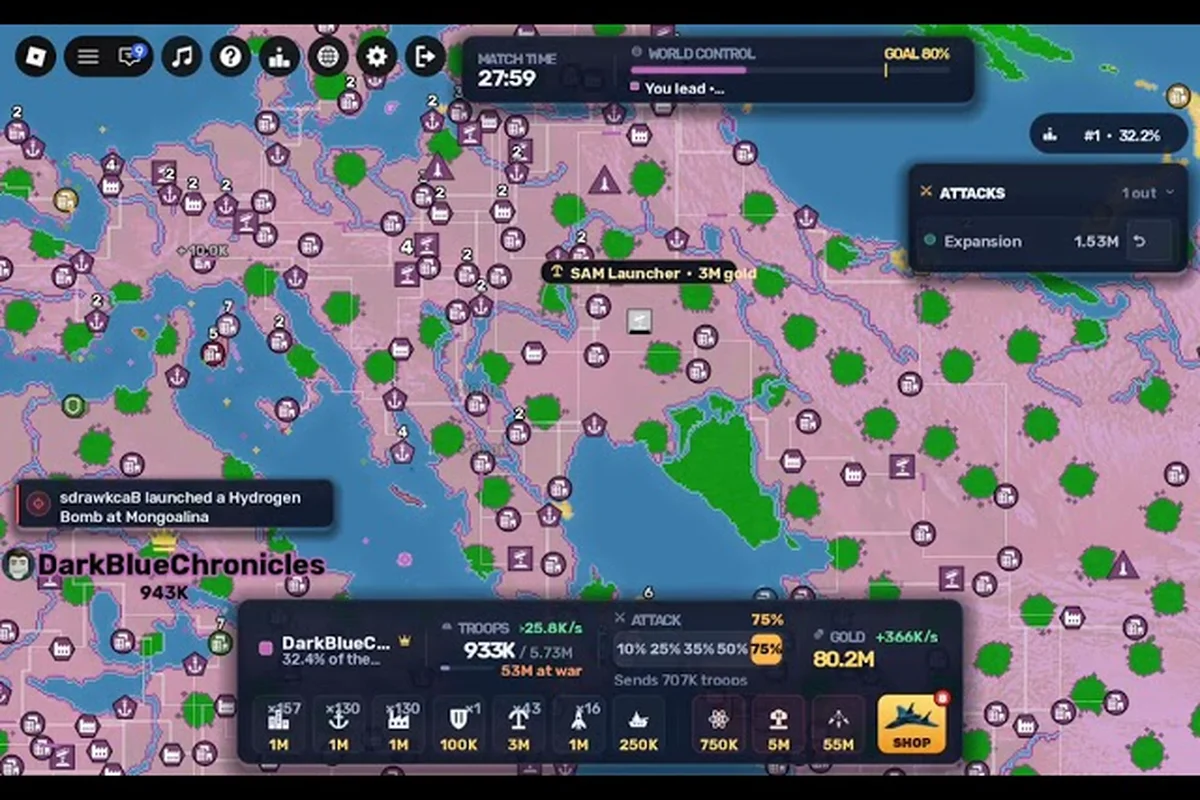
RoWorld building upkeep determines whether your economy grows or collapses under repeated costs. The official RoWorld game page confirms cities, ports, and factories exist, so smart spending matters even before you fight for territory.
Why roWorld Building Upkeep Needs a Clear Plan
RoWorld building upkeep is the repeated cost of keeping infrastructure and armed forces active. Although the game does not publish exact prices or income rates, community reports consistently describe the same danger: buying every possible upgrade before income becomes stable leaves a nation unable to respond to a border attack. A sound plan therefore separates essential spending, defensive readiness, and optional expansion.
The official page lists cities, ports, and factories among the core building types. It also identifies an 80% world-control victory condition and supports as many as 55 players per server, making efficient infrastructure relevant on a crowded board. Your choices should support both steady revenue and enough capacity to protect what you already own.
| Spending layer | Main purpose | Best time to fund it | What can wait |
|---|---|---|---|
| Core economy | Increase and stabilize income | After the first viable capital | Cosmetic or low-impact additions |
| Border defense | Protect threatened territory | When enemies are nearby | A second defensive line when the first is secure |
| Military capacity | Support attacks and reserves | After core income works | Mass recruitment before the treasury is stable |
| Strategic expansion | Open new routes and markets | When current borders are consolidated | Unconnected buildings and scattered projects |
This framework turns roWorld gold spending into a sequence rather than a shopping list. It also establishes the roWorld gold priority: protect income first, secure the threatened border second, and pursue expansion only after both remain stable. For example, if a city or port upgrade is affordable, but a nearby border is exposed and a factory is still producing core economy resources, the city or port should take precedence; a 55-player server can punish an isolated upgrade that cannot be defended. Reserve enough gold for a defensive response, then redirect surplus toward ports, factories, and connected expansion routes.
Track Spending by Function, Not by Building Name
Because exact roWorld building upkeep figures are not published, use observed treasury changes to build your own baseline. For example, record the gold difference before and after a City upkeep payment, then compare it with the income generated by the connected Factory, Port, or resource buildings; categorize each expense by its economic function rather than by building name. This functional view makes it easier to identify whether a payment is strengthening income, maintaining military readiness, or funding expansion, and prevents a costly upkeep chain from consuming gold that could support a more profitable building.
| Expense category | What it indicates | Healthy pattern |
|---|---|---|
| City upkeep | Commitment to your economic core | Stable or productive |
| Factory upkeep | Commitment to production capacity | Supported by income |
| Port upkeep | Commitment to coastal access | Connected to a clear need |
| Troop upkeep | Commitment to military readiness | Matched by threat level |
| Optional upgrades | Preference or expansion | Delayed when cash is tight |
Record the change after each purchase, wait long enough to observe whether the effect stabilizes, and then decide whether the next payment is justified. The goal is not to spend nothing; it is to make each purchase reinforce income, defense, or a validated expansion route.
For a broader look at earning the funds required for this process, use the roWorld gold guide to build an income plan before committing to a long upkeep chain. Treat the plan as a reserve test: estimate the gold generated by connected Factory, Port, and resource buildings, then compare that income with the next City, troop, or upgrade payment. If a payment would leave too little treasury income for another maintenance cycle, postpone the optional upgrade until the economic core has recovered its cost.
roWorld What to Spend Gold On First
The best early purchases reinforce the resources that pay future costs. A city connected to productive territory provides the foundation; a factory becomes more valuable when the capital can already support it; and a port matters when it opens a practical coastal route rather than occupying an isolated tile.
Start by asking three questions. Does the building generate or protect something the nation already needs? Does its position fit the capital and future territory? Can the treasury absorb its upkeep if a battle goes badly? If the answer to any question is no, the purchase is better delayed.
The Essential Core
Your opening priority should be a functioning capital and enough city coverage to support the early roster. This creates a dependable base without spreading gold across distant projects. Cities connected to secure territory are generally more defensible than isolated structures, because enemies must cross more of your controlled land to reach them.
Factories come next when your capital can support both economic growth and pressure from a neighbor. Their value depends on sustained demand, not merely their presence. A port receives similar scrutiny: coastal access matters, but only when its placement supports shipping, defense, or a future invasion route.
| Early target | Why it deserves priority | Warning sign before buying |
|---|---|---|
| Reliable capital | Anchors territory, income, and defense | Your capital remains under pressure |
| Connected city coverage | Supports revenue without scattered risks | Cities are isolated from one another |
| Production capacity | Strengthens the economic cycle | You cannot fund existing upkeep |
| Coastal access | Enables a distinct strategic route | The port serves no useful route |
| Emergency reserves | Covers temporary income loss | Your reserve is already spent |
The order is more important than the exact building count. Capital stability comes first, connected income second, and strategic infrastructure third. For example, securing a capital that can still pay building upkeep should precede buying a second factory; likewise, a port is worth more when it completes a shipping route between connected cities than when it sits beside an already supplied coastline. A large but incoherent network is more expensive to maintain than a smaller network that works, because every isolated city, factory, and port adds upkeep without strengthening the same gold-income cycle.
For placement details, the roWorld building placement guide explains how location changes the value of cities, factories, ports, and other structures. For upkeep planning, check whether each building extends the same connected gold-income cycle: a city beside productive territory may offset more upkeep than an isolated one, while a factory should ideally serve a supplied market and a port should complete a useful shipping route. If a structure adds a second supply chain without improving income, its additional roWorld gold spending can strain the reserve sooner than its production value suggests.
Spending That Can Wait
Several categories are tempting but weak during the opening. Upgrading a nonessential structure before your core economy is stable, building a second port without a coastal plan, and adding distant defensive buildings across empty territory all increase upkeep without creating a dependable return.
The same applies to military recruitment. A large army is not automatically safer than a smaller force supported by sound infrastructure. Troops have ongoing upkeep, and a sudden mass purchase can interrupt the very economy needed to replace losses. Recruit when a threat exists, reserve a meaningful portion of available gold, and avoid treating troops as a substitute for border geometry.
Community reports consistently advise the same sequence: establish income, build a defensive core, and then prepare an offensive. This order limits roWorld building upkeep because each gold payment should either strengthen your roWorld gold income or reduce a specific threat. For example, secure a productive resource chain before constructing a remote offensive landmark, then use the defensive core to protect borders while saving for units; buying military power first can leave the treasury unable to cover both troop wages and essential building maintenance.
Managing the roWorld Early Game Economy
The roWorld early game economy is a sequencing problem. Every new building can improve your position, but it also introduces a recurring commitment before the benefits are fully proven. Players should therefore reserve enough gold to survive a short income dip, a border emergency, or an unexpected attack before buying optional capacity.
Use a Three-Bucket Treasury
Divide your available gold into three mental buckets: operating funds for essential income and infrastructure, defense reserves for threatened borders and temporary income losses, and expansion funds for a planned city, factory, port, or route. For example, if a port would consume 300 gold while an infrastructure upgrade needs 200, keep the 300 in expansion funds until operating upkeep and a realistic emergency reserve are secured; otherwise several attractive buildings compete for the same treasury and expose a deficit before the next income cycle.
| Treasury bucket | Purpose | Spending rule |
|---|---|---|
| Operating funds | Covers essential income and infrastructure | Spend only on assets that reinforce the core |
| Defense reserves | Covers threatened borders and temporary losses | Release when a real danger appears |
| Expansion funds | Supports a planned city, factory, port, or route | Use only after core upkeep is covered |
This approach makes roWorld building upkeep visible. If essential infrastructure requires money that was meant for a new port, the nation has already entered a deficit state even if the treasury does not display one. The buckets expose that conflict before an attack or missed income cycle does.
A practical review should ask whether the current structure is producing value, whether reserves cover the most likely emergency, and whether expansion supports the direction in which you are already growing. If the answer to the first question is uncertain, keep the reserve intact.
Measure the Next Purchase Before Committing
For every major purchase, write a one-sentence justification: “This purchase increases income,” “This purchase protects a threatened border,” or “This purchase enables a connected expansion route.” If the sentence does not fit, the purchase is probably optional. It may still be desirable, but it should not outrank core necessities.
| Reason for purchase | Supporting evidence | Decision |
|---|---|---|
| Income support | Current income is insufficient for recurring costs | Fund it soon |
| Border protection | A neighbor can reach an important asset | Fund it before the attack |
| Route opening | A new port or city connects to planned territory | Fund it during consolidation |
| General expansion | The project is desirable but not required | Delay if reserves are thin |
| Duplicate coverage | The area already has safe infrastructure | Avoid unless a new threat exists |
The official game page confirms the broader strategic pressure: the board supports numerous player nations, cities, ports, factories, alliances, and nuclear weapons. That does not mean every player should use every system immediately. It means infrastructure has to be chosen in the context of competition, because an isolated asset can become a liability when enemies approach from another direction.
roWorld Mid Game Economy Decisions
The roWorld mid game economy changes because territory, income, and enemy pressure become interdependent. A capital that produced a safe opening may now sit behind several borders, while a coastal city may gain value as shipping routes become contested. Mid-game spending should respond to those changing conditions rather than repeat the opening order.
Upgrade the Bottleneck, Not the Most Visible Building
The most expensive-looking structure is not automatically the best next investment. Examine what currently prevents the nation from using its assets efficiently. If cities lack secure territory, extend only the safe portion of the network. If factories are productive but unreachable, improve the route that links them to the capital. If a port is exposed, strengthen that approach before adding another coastal project.
| Mid-game symptom | Likely budget conflict | Better allocation |
|---|---|---|
| Cities earn poorly | Territory is unsafe or disconnected | Secure and connect nearby land |
| Factories lack value | Production has no route to demand | Improve logistics before capacity |
| Ports are exposed | Coastal defense is too thin | Fortify the access route first |
| Treasury recovers slowly | Too many overlapping projects | Pause nonessential upkeep |
| Attacks are frequent | Defense consumes working capital | Defend the core, then rebalance |
This is where roWorld gold priority becomes dynamic. Early in the match, income support may dominate. During the mid game, a single bottleneck can outweigh several small purchases. The best spender is not necessarily the structure with the greatest strategic potential; it is the project that removes the most immediate constraint.
Keep Expansion Near Your Strength
Expansion is safer when it extends a route the nation already understands. If your economy depends on inland cities, a distant port may take too much gold to secure. If your strength is coastal, extending along the shoreline may create a coherent network with fewer exposed transitions.
The roWorld infrastructure guide can help with the relationship between economic buildings, military structures, and defensive coverage. The important principle is continuity: each new structure should strengthen a route that already produces income or protection.
Reserve Before a Major Offensive
An offensive changes the economy immediately. Territory may add value, but captured assets can also require defense, repairs, and further infrastructure. A large pre-attack purchase leaves no margin for a failed assault. Reserve enough to cover existing upkeep, a basic defense, and a limited follow-up if the operation succeeds.
| Attack stage | Treasury requirement | Spending attitude |
|---|---|---|
| Planning | Preserve operating funds | Avoid speculative construction |
| Mobilization | Fund necessary force without exhausting reserves | Do not recruit beyond the plan |
| Assault | Keep emergency defense available | Avoid simultaneous expansion |
| Consolidation | Restore the reserve first | Delay optional upgrades |
| Exploitation | Connect and protect new territory | Expand from proven income |
This reserve discipline also prevents one failed attack from undoing months of economy building. For example, if 1,000 gold is needed for troop upkeep and another 300 for basic defense, a commander should not commit the full treasury to recruitment and leave nothing for emergencies. Keeping the smaller amount available after mobilization limits the damage from a counterattack, while restoring the reserve before optional construction keeps future gold income stable.
Building Upkeep Scenarios and Gold Priorities
Three scenarios show why identical spending plans fail. Each one represents a common competitive situation rather than a fixed game state. Since exact values are not published, the correct response depends on the condition of the treasury, the location of the threat, and the maturity of the economy.
Scenario A: Stable Income, Thin Reserves
A nation with reliable income but little spare gold can often afford one carefully chosen upgrade. The problem is not affordability in isolation; it is the repeated cost that follows. Choose a project that protects the income core or removes a current bottleneck, then rebuild the reserve.
Under this scenario, roWorld what to spend gold on has a narrow answer: essential economy first, the most exposed border second, and optional construction last. Avoid spreading a limited budget across several distant projects. Concentrating spending around one coherent area produces more security and easier management.
Scenario B: High Income, Repeated Border Pressure
A nation earning steadily but losing territory may need to change its defensive structure rather than buy more production. Determine where attacks repeatedly begin and where the enemy can access key cities or routes. Place the next defensive investment along that problem, not around the capital merely because it feels safer.
Fewer strategic assets with better coverage can be more gold-efficient than a scattered defense. Since territory control and connected resource nodes underpin the match economy, one fortified junction can protect multiple cities, border routes, and production sites. For example, if attacks repeatedly target the same pass, strengthening that choke point may preserve nearby gold income and reduce repair costs more effectively than adding isolated defenses around individual landmarks.
Scenario C: Weak Income, Ambitious Expansion
A nation trying to spread faster than its economy can support should stop expanding and simplify the network. Pause nonessential structures, reconnect assets that contribute to income, and preserve enough gold to cover the existing upkeep. Expansion resumes only after the core is no longer competing with itself.
| Constraint | Immediate action | Avoid |
|---|---|---|
| Weak income | Consolidate the economic core | More remote construction |
| Thin reserves | Delay optional purchases | Recruiting for appearance |
| Border pressure | Defend the exposed approach | Spending across unrelated areas |
| Recent conquest | Secure and connect captured land | Instant new expansion |
| Stable economy | Reassess bottleneck | Keeping purchases on autopilot |
These scenarios also reveal a broader rule: upkeep pressure should determine the size and location of the next purchase, while strategic value determines which purchase is worth making. For example, if remote construction raises recurring gold upkeep before the connecting economy can produce enough income, a smaller structure near a productive gold mine may be the better roWorld gold priority. Cost alone does not tell you whether a building is good; compare its build price with its ongoing upkeep, the income or defense it enables, and the pressure it adds to thin reserves.
A Repeatable Weekly-Style Budget Review
Review the economy at regular intervals rather than after every individual click. The schedule can be flexible, but the review should occur before major purchases and whenever the threat level changes. A useful audit combines your own observed costs with the strategic role of each asset.
Audit Every Major Asset
Divide the treasury into operating, reserve, and expansion portions. Then classify every city, factory, port, defensive structure, and troop group by its current purpose. Remove anything that is neither supporting income nor protecting a defined area. Do not delete the structure immediately; first consider whether selling, merging, or ignoring it is available and practical.
The review should produce a short list of immediate actions: record each major asset’s daily gold output, maintenance cost, troop coverage, and connection value; flag assets that drain the operating fund without supporting income or defense; and note which repairs, sales, or upgrades would have the shortest payback. For example, if a remote port costs more in upkeep than it contributes, merge its supply role before investing in roads, while a capital-facing factory that regularly feeds troop groups should be prioritized for efficiency upgrades.
-
Protect the capital and income-producing territory.
-
Connect the most valuable existing assets.
-
Upgrade only the infrastructure causing the clearest constraint.
-
Maintain a reserve before funding a new operation.
-
Delay expansion that requires multiple distant buildings at once.
-
Recheck the plan when a neighbor changes the border situation.
Track Direction, Not Just Totals
A larger treasury can conceal a worsening position because reserve gold is useful only while income, upkeep, and territorial control remain aligned. If income fell while upkeep commitments grew, the apparent gold total may no longer represent a healthy economy. For example, a 500-gold reserve looks stronger than a 300-gold reserve, but it is weaker if recurring building upkeep has risen by 200 and secure territory no longer offsets that cost. At each review, record the direction of income, upkeep, reserves, and territorial security, then check whether higher spending was matched by rising income or merely reduced available gold.
| Review signal | Positive direction | Warning direction |
|---|---|---|
| Income | Stable or rising | Falling over multiple checks |
| Upkeep | Supported by income | Growing faster than income |
| Reserves | Recovering after spending | Remaining depleted |
| Territory | Secure and connected | Fragmented or exposed |
| Spending | Aligned with bottlenecks | Scattered across low-impact goals |
This directional approach is particularly useful in the middle phase, when the game becomes less about discovering a simple opening routine and more about maintaining many linked systems. To understand how that phase can develop into a snowball, the roWorld late-game economy guide explains how gold, troops, and territorial control should reinforce one another.
The final rule is to spend only after identifying the constraint. If income is weak, strengthen the economy. If reserves are weak, pause. If borders are weak, defend the route. If the core is healthy and the route is secured, then expansion becomes the rational next step.
Frequently Asked Questions
What is the most important rule for roWorld building upkeep?
Keep recurring infrastructure costs supported by reliable income, and retain a reserve before buying optional capacity. Exact prices are not published, so judge each purchase by observed treasury changes and strategic purpose. Cities, factories, ports, troops, and defensive assets should reinforce a clear plan rather than compete for the same gold without priority.
Should players build factories before securing more territory?
Usually not. A factory is more valuable when production has a secure route to the capital or another active part of the network. First establish dependable income and protected land, then add production capacity where it solves a visible bottleneck. A large factory count cannot compensate for exposed cities, disconnected routes, or an empty reserve.
How should players decide between a city and a port?
Choose based on the role each must play in the nation. A city supports the inland economic core, while a port extends coastal access and may support trade, defense, or naval movement. If your current network already meets inland demand, consider a port only when the coastline affects your strategy. If coastal trade is irrelevant, another city may produce a clearer return.
Can a large army solve an economy problem?
No. Troops create continuing upkeep and do not automatically produce income. They can protect valuable territory and support an offensive, but recruiting first may weaken the infrastructure needed to replace losses. Build a sustainable economic core, keep a defensive reserve, and recruit to a defined threat or operational objective rather than treating troop count as a substitute for economy.
Is it better to save gold or buy infrastructure during the mid game?
The answer depends on the nation’s bottleneck and reserve level. Save when essential upkeep is unstable, borders are threatened, or a planned purchase would consume the emergency fund. Buy when a specific upgrade clearly improves income, connectivity, or defense and the treasury can still cover existing costs. This prevents both paralysis and reckless overextension.