
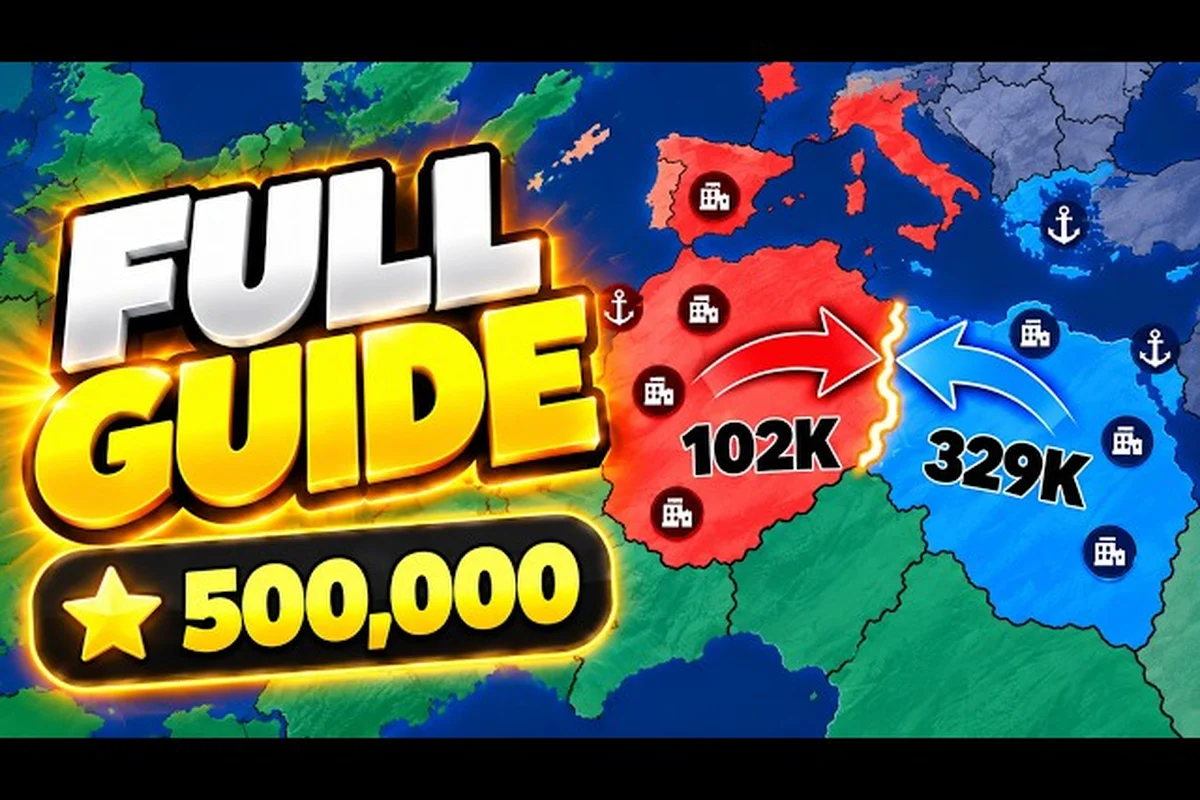
A complete roWorld walkthrough helps you turn a small start into a viable nation: choose your capital for early resource access, balance construction with research, learn the roWorld controls, and decide when expansion or war is worth the cost. For example, securing nearby food and income before recruiting troops reduces production strain, while delaying unnecessary borders prevents you from overextending your economy. Understanding the research queue and control layout also lets you direct resources efficiently instead of reacting to constant notifications.
RoWorld Basics: What the First Match Expects
RoWorld is a real-time strategy game on Roblox where nations compete across a shared world. The official RoWorld game page lists 88 player nations, hundreds of tribes, cities, ports, factories, alliances, and nuclear weapons. Its stated victory condition is controlling 80% of the world, while a server can accommodate up to 55 players.
That scale makes a clear opening plan essential. Players begin by choosing a nation, establishing a capital, claiming nearby territory, and meeting neighboring competitors. You do not need to conquer the map immediately. A safer first goal is to create a compact territory with enough land, resources, and troops to survive the early pressure.
This roWorld walkthrough focuses on practical decisions rather than invented numbers. The developers have not published official building costs, income rates, troop multipliers, attack percentages, or upkeep values, so this guide uses observable priorities and community-tested strategy principles instead. Treat that as a planning rule rather than a fixed statistic.
The opening objective sequence
Your first match should follow a deliberate sequence, because each opening action affects what actions are available later. For example, securing nearby empty land before establishing economic buildings keeps your capital connected to a useful expansion area, while a defended border gives newly recruited troops a clear position from which to respond. The six-stage sequence below treats nation choice, capital placement, expansion, economy, defense, and troop reserves as connected decisions rather than independent checklist items.
| Sequence | Immediate objective | Reason it matters |
|---|---|---|
| 1 | Choose a starting nation | Your nation defines your location, neighbors, and expansion options |
| 2 | Place your capital | This anchors your territory and enables further development |
| 3 | Claim nearby empty land | Nearby expansion reduces exposure to distant rivals |
| 4 | Establish economic buildings | A stable economy supports later construction and troop needs |
| 5 | Build a defended border | You can expand without treating every direction as equally urgent |
| 6 | Recruit and preserve troops | Reserves let you respond when a neighboring nation tests your border |
What matters in the opening
Territory continuity, economic stability, and border security matter more than a dramatic first attack in roWorld. Community footage shows a consistent opening pattern: claim nearby empty tiles first, avoid stronger neighboring powers, and keep enough troops at home to defend against counterattacks. For example, expanding into an undefended tile while leaving only a small garrison exposed can turn a safe economy into a border crisis. Holding a defensive line until production and troop reserves improve usually creates better conditions for a later offensive than attacking immediately for a quick capture.
roWorld adapts the core real-time territory mechanics of OpenFront.io, but its Roblox version may differ in balance. The upstream project is useful for understanding the general style of play, not for importing numbers into this game. For a roWorld walkthrough, treat troop costs, tile yields, build timers, and attack strength as Roblox-specific values that need verification in the current build; copying OpenFront.io’s economy tables can otherwise make a safe opening look stronger or weaker than it really is. If a guide shows a fixed troop cost or capture rate, compare it with in-game values before planning expansion, and use roWorld’s own training match or early-game results as the baseline for timing.
RoWorld Controls and First Actions
Learning the roWorld controls quickly matters because territory decisions happen in real time. A short delay can allow a rival to approach an open border, claim useful land, or contest your next expansion route. Start with the interface, understand the purpose of each available tool, and avoid spending resources simply because an option appears highlighted.
The precise button labels can change as the interface develops, so use the visual categories below instead of assuming every control has a permanent name. If you want a shorter orientation, the roWorld beginner guide provides a focused introduction to your first match.
Core control groups
| Control group | What it does | Practical use |
|---|---|---|
| Map movement | Moves the camera across the territory | Finds borders, opponents, and unclaimed land |
| Selection tool | Selects your nation, army, or owned territory | Confirms targets before issuing commands |
| Build or construction tool | Opens available structures | Adds economic, military, or logistical capability |
| Unit command | Directs selected troops | Moves, holds, attacks, or responds to threats |
| Diplomacy or alliance interface | Manages relations with other nations | Creates support without a prolonged border fight |
| Notification or alert feed | Reports attacks and important events | Helps prevent simultaneous emergencies elsewhere |
The first five minutes
Once the match begins, look at the map before moving your camera. Identify your capital location, nearby empty tiles, the nearest nations, and the directions with the most available space. This scan gives you a basis for choosing a capital position and prevents the common mistake of expanding in several directions without understanding what surrounds you.
| Moment | Action | Beginner-friendly reason |
|---|---|---|
| Match start | Check neighboring nations and unclaimed land | Reveals which routes are open and which are contested |
| Capital phase | Place your capital on a useful central position | Supports nearby expansion and future defense |
| First expansion | Claim adjoining empty territory first | Keeps your land connected and reduces travel risk |
| Economy phase | Add useful buildings near developed land | Supports further growth without exposing distant settlements |
| Contact phase | Observe the closest rival | Reveals whether diplomacy or defense should come first |
Avoid spending every resource immediately
New players often build too many structures and then discover that the army budget has disappeared. The better approach is to preserve at least one practical reserve for defense, especially after a neighbor approaches. Since the game does not publish exact percentages, treat this as a strategic cushion rather than a fixed troop requirement.
You can also rotate between the camera and construction interface. Checking every few moments may be efficient for economy management, but continuously watching one border can allow another player to act elsewhere. Rapid map awareness is therefore a useful roWorld control habit even when you are not commanding troops.
Building a Stable First Territory
Your early territory should be small, connected, and economically useful. That approach gives you room to react to stronger players. A scattered realm may look larger on the map, but it can be harder to defend and less effective if its cities or ports sit far from your capital.
The roWorld early game guide can help you connect these opening choices to the middle and late phases of a match. For the first phase, however, the central question is simple: does each building or land claim reinforce another part of your nation?
Choose a capital position by function
A good capital is not merely an empty patch with room around it. Its surroundings should support movement, defense, and expansion. Coastal positions can be useful when your strategy relies on ports or naval movement, while inland positions may offer different routes into the interior. The best choice depends on the match, neighboring players, and your intended build.
| Capital characteristic | Useful when | Possible drawback |
|---|---|---|
| Central among empty land | You want room to claim a compact region | May border several directions |
| Near the coast | You plan to use ports or boats | Exposes naval routes to rivals |
| Inland | You prefer land-based growth | Can limit access to coastal projects |
| Close to a weak neighbor | You may negotiate or conquer early | A stronger player can threaten the same border |
| Separated from major rivals | You want a calmer development phase | Fewer immediate targets for expansion |
Build for the current problem, not an empty slot
Buildings should answer a current problem rather than fill empty slots. A production structure is more valuable when your territory has demand, a military structure is more useful when you can protect what you own, and a transport-related building matters only if your strategy needs a corresponding route.
| Building type | Primary role | Best placement principle |
|---|---|---|
| City | Extend or reinforce territorial control | Near the center of the territory you intend to hold |
| Factory | Support military or industrial development | Where it can operate without becoming an isolated target |
| Port | Enable maritime activity and transport | On a coast that fits your wider strategic plan |
| Military structure | Improve defense or support troop operations | Near the border or area that needs protection |
| Support structure | Strengthen another part of your nation | Close enough to benefit the intended area |
The official game page confirms that cities, ports, factories, and nuclear weapons are part of RoWorld, but it does not publish their costs or exact effects. Avoid buying expensive confrontational options until you understand their role. More building buttons does not automatically mean a stronger economy.
Keep the land shape coherent
Connected expansion makes administration and defense easier because your territories reinforce one another. When selecting a new tile, check whether it continues your existing footprint instead of opening an isolated claim. If an attractive resource area lies far away, secure the route first and treat the distant position as a later objective.
Community players commonly describe the same early-game principle: consolidate first, then contest one front. That approach is especially effective when a match contains several active nations, because fighting one opponent at a time prevents your army from becoming stretched across separate fronts.
Expansion routes that keep one safe border
Expansion should come from a controlled plan rather than constant tile claiming. Your route should account for neighboring strength, economic readiness, army reserves, and the possibility that another player will attack while your attention is directed outward. A larger map position is useful only if you can still protect the land behind your front.
For deeper planning, the roWorld strategy guide examines broader approaches to expansion and conflict. In this walkthrough, the key is to recognize three kinds of land: safe adjacent space, contested space, and dangerous remote space. Use it to choose the next move, then confirm details in the live match.
Classify expansion routes
| Route type | Description | Recommended priority |
|---|---|---|
| Adjacent empty land | Unclaimed territory touching your existing border | Expand here first |
| Neutral corridor | Open land connecting two strategic areas | Secure before rivals cut access |
| Contested border | Territory beside an established nation | Observe and prepare before entering |
| Distant objective | Valuable but separated by other territory | Develop only after the core nation is stable |
| Enemy-held land | Land belonging to another nation | Consider last, or when circumstances clearly favor action |
Use borders as decision points
When you approach another nation, pause before claiming. Compare their visible land with your own, identify whether they have been expanding aggressively, and consider whether an alliance is possible. Sometimes the best territorial move is not a fight but a negotiated border that lets both sides focus on a larger threat.
Whenever a border appears, pause for three checks: the neighbor’s current activity, your own internal reserve, and the potential value of cooperation. For example, if a player is already fighting on another front, a sudden claim may force you to split troops; if your reserve is needed to defend core territory, a second front may be too costly; and if a non-aggression pact or trade would stabilize your rear, it may be smarter than an immediate conquest. These checks help you avoid overextending your army and preserve income for the next expansion opportunity.
-
Is the neighboring player already active on another front?
-
Can you protect the border without removing your internal reserve?
-
Would cooperation create more value than an immediate conquest?
Community experience favors one major war at a time. This is not a published rule, but it is a practical way to avoid dividing attention. If you must fight, concentrate troops, protect the territory behind the front, and avoid opening a second conflict until your income and army can support it.
Treat diplomacy as a map decision
Alliances can change the strategic balance because an ally can absorb pressure from one direction while you focus on development. Before approaching another player, identify what they need. A nation threatened on two sides may value support more than a large territorial promise, while a peaceful neighbor may simply need a clear border agreement.
Do not treat an alliance as a permanent solution. Borders, player priorities, and match conditions can change, so use each pact as temporary support rather than a substitute for development. For example, if an ally blocks a northern invasion while your army handles an eastern attack, continue upgrading your cities, securing resources, and checking border access; otherwise, a sudden border shift can leave your nation exposed. Cooperation strengthens a viable nation when it buys time to improve your own position, not when it conceals a major weakness.
Recruiting, Fighting, and Defending Effectively
Military decisions should follow economic readiness. Training troops because an attack option is available can leave your nation vulnerable, especially if buildings and territory still need support. The strongest early approach is usually to create a dependable reserve, watch the closest border, and choose a fight where your position is favorable.
Before you attack
| Check | Positive sign | Warning sign |
|---|---|---|
| Army strength | You can protect your capital and home territory | Almost all troops are committed to one attack |
| Target readiness | The rival is focused elsewhere | The rival is already advancing toward you |
| Economic support | You can continue developing after combat | A prolonged fight will stall construction |
| Geographic access | The target is close and connected | A long route exposes supply and retreat lines |
| Strategic value | The target supports a larger objective | The prize creates a dangerous new border |
Defensive priorities
Defense often starts with positioning rather than a dramatic battle. Fortify the border most likely to be tested, keep a mobile troop group available, and avoid leaving every unit tied to one distant objective. If your opponent attacks while your army is elsewhere, even a strong force can arrive too late to protect your capital.
Early-warning awareness is one of the most important lessons from this roWorld walkthrough. Watch movement near your territory, respond to alerts, and treat repeated border activity as a signal to reinforce or negotiate. You do not need to win every engagement; you need to prevent one opponent from dismantling your core.
When to negotiate
Negotiation becomes attractive when a fight would consume resources without securing a clear benefit. You may also need peace after winning a border skirmish, especially if another nation is approaching from a separate direction. A compact agreement can preserve both players’ ability to function, although you should still maintain enough strength for enforcement.
If nuclear weapons appear in the interface, do not treat them as an automatic first answer. The official listing includes them among the game’s features, yet no official damage, cost, or cooldown figures are published. Test what the interface explains in that match, and use only what you understand.
First-Match Routine and Common Mistakes
A repeatable routine prevents rookie mistakes because each early decision affects later positioning, economy, and army strength. Review the map, check your borders, maintain your economy, and assess your army before making a major commitment. For example, if a new land claim leaves an exposed border, reinforce that border before expanding again; likewise, compare your army strength and strategic position when a rival appears, then negotiate or avoid a fight when your reserves cannot cover the risk. The goal is not perfect play, but consistent priority checks that keep expansion, resource management, and combat preparation from competing against one another.
| Time or trigger | Routine check | Action if something is wrong |
|---|---|---|
| After placing the capital | Verify nearby routes and neighbors | Correct the expansion direction early |
| After each land claim | Check for a new exposed border | Reinforce or pause expansion |
| When a rival appears | Compare army and strategic position | Reinforce, negotiate, or avoid a bad fight |
| Before a major construction | Check reserves and other needs | Delay if it creates a critical weakness |
| Before attacking | Review home-front security | Recall or protect exposed territory |
| Late in the match | Compare your progress with the victory goal | Shift from local expansion toward larger targets |
Frequent mistakes and corrections
Starting in several directions at once fragments your attention. Choose one compact growth area, develop it, and only then consider a second axis. The correction is simple: claim adjacent land first and ask whether your capital remains safe throughout the expansion.
Attacking without an economic foundation can produce a short victory followed by an unwinnable position. In roWorld, troops consume the nation’s production capacity, so a rapid offensive can leave farms, resource buildings, and your capital under-defended even while enemy units fall. Before committing troops, establish a connected economic base, maintain a production reserve, and check whether your income can recover if the opponent redirects units toward your home territory.
Leaving home territory undefended makes a distant target tempting but risky. Even if your army is larger, the opponent may capture your capital or critical structures while you are away. Before issuing an offensive order, compare your available troops with the defenders required to protect nearby farms, resource buildings, and the capital; otherwise, a single counterattack can turn a numerical advantage into a losing position.
Spreading buildings across distant territory weakens their usefulness. Develop a connected core first, then add specialized structures where they support a clear plan. The roWorld how to build guide offers more detail on practical construction choices. That keeps expectations realistic whenever the board or patch changes.
Treating every neighbor as an enemy can create unnecessary pressure in the roWorld walkthrough. Track each neighboring faction’s troop movements and production capacity, then judge which border is genuinely threatened instead of ordering attacks against every visible unit. For example, if one opponent expands near your farms while another is separated by neutral territory, protect the first border and preserve a defensive reserve. A stable, connected territory is often more valuable than an easy conquest that diverts production away from your capital and resource buildings.
A Complete First-Match Checklist
Before you finish the walkthrough, verify that you can execute the entire opening sequence without relying on random clicking. Use the checklist below as a practical benchmark. It does not prescribe exact costs or timings, because the game has not released official values for those details.
- I chose a nation based on its surroundings rather than appearance alone.
- I placed my capital in a position that supported a coherent territory.
- I claimed nearby empty land before distant objectives.
- I developed economic buildings before committing heavily to military actions.
- I kept a practical reserve for defense and emergencies.
- I identified my strongest nearby neighbor and watched their movements.
- I considered diplomacy before treating every border as a war.
- I concentrated on one front instead of opening multiple conflicts.
- I protected my capital and core territory before launching an attack.
- I reviewed the official 80% control objective as the long-term target.
You should now be ready to begin a cleaner first match. The central rule of this roWorld tutorial is simple: build a connected economy, protect one front at a time, and expand only when your next move does not expose your capital or core territory.
Frequently Asked Questions
What is the best way to start RoWorld as a new player?
Begin by choosing a nation with nearby unclaimed land, then place your capital where you can expand in a compact direction. Claim adjacent territory before distant objectives, establish your economy, and keep troops available for defense. Avoid attacking a stronger neighbor until your capital and core buildings are secure.
What are the most important RoWorld controls to learn first?
Learn map movement, territory selection, construction, troop commands, and the alert feed. These controls cover camera awareness, expansion, economic development, combat, and emergency response. Practice selecting units and checking borders before using advanced features, because basic positioning and map awareness improve nearly every early decision.
Should every new player attack another nation immediately?
No. A first attack is safer after you have a connected territory, a functioning economy, and enough troops to protect your home position. Community players often recommend fighting one front at a time because simultaneous conflicts can stretch your army too thin. Diplomacy may also be useful when both nations face pressure elsewhere.
How do cities, factories, and ports fit into a first strategy?
Each structure should support a clear need. Cities extend and reinforce territorial control, factories support development, and ports enable maritime activity. Place them within a coherent area and avoid building only because an option is available. Exact costs and official effects are not published, so prioritize role and placement over raw structure count.
What does the roWorld walkthrough teach about winning the match?
The official victory condition is controlling 80% of the world, so early efficiency matters more than an isolated conquest. Develop a stable base, expand through useful corridors, protect your capital, and choose fights that support wider control. As your position improves, shift attention from local survival toward regional objectives and major territorial gains.