
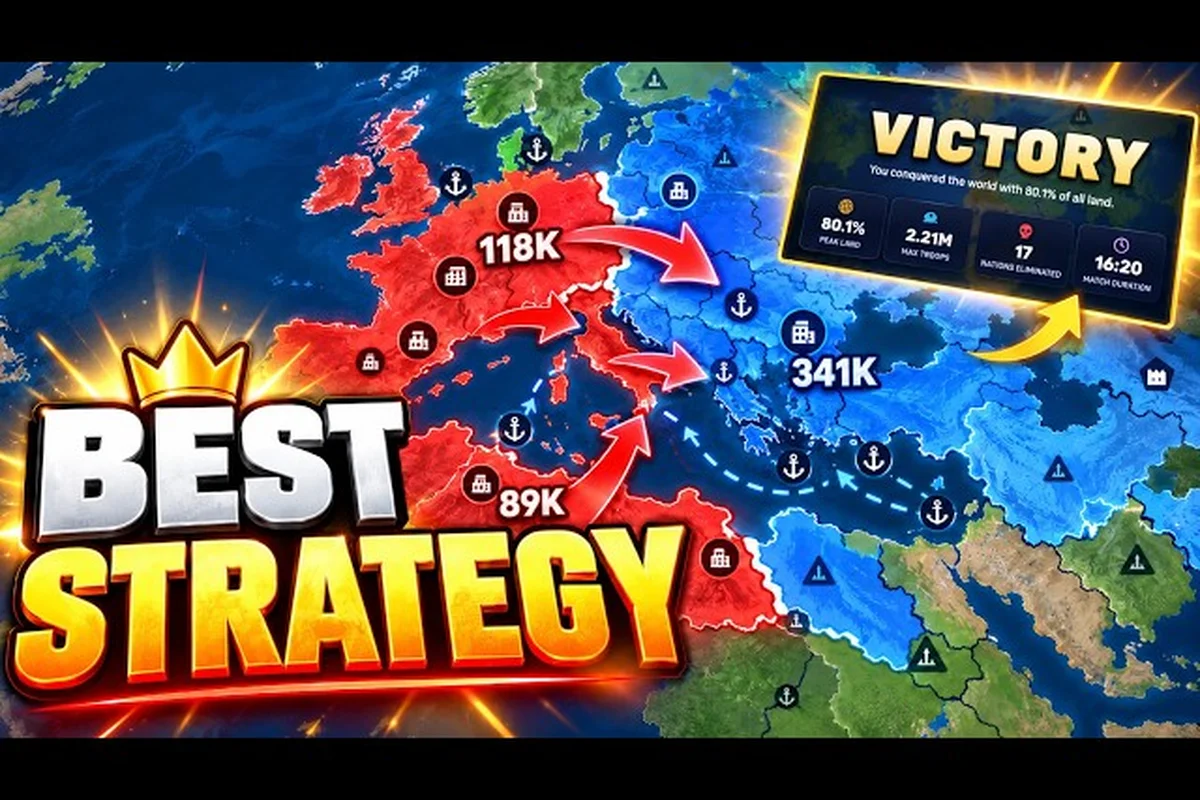
RoWorld b tier nations matter because a strong opening can support stable growth without immediately making a country a target for conquest. The ranking compares C-tier and D-tier choices through border safety, expansion room, water access, and conquest potential, helping players identify which offers the better balance between early development and long-term positioning in the roWorld nation rankings.
RoWorld B tier nations: how the middle rankings work
RoWorld b tier nations are strategic openings rather than officially measured power ratings. The official RoWorld game page describes 88 player nations, hundreds of tribes, and a victory condition built around controlling 80% of the world. Because no official per-nation statistics are published, these placements use practical map and economy considerations rather than invented win rates.
The middle tiers are especially useful because they sit between strong early starts and difficult siege positions. A nation may begin without the safest capital placement or most abundant resources, yet still offer a believable route to expansion if the player protects its borders and chooses a sensible building order.
| Ranking element | What it measures | Why it affects a nation's tier |
|---|---|---|
| Capital position | Exposure on several land borders | A crowded opening can attract pressure before economy develops |
| Coastal access | Availability of ports and water routes | Ports can support expansion, but also create maritime threats |
| Interior space | Room to absorb new territory | Open land can provide safer growth away from immediate rivals |
| Economic potential | Capacity to support buildings and expansion | A viable economy creates more options after contact |
| Conquest path | Practical route to nearby territory | A strong position must still be connected to useful land |
| Strategic flexibility | Ability to alternate between growth and defense | Flexible starts survive uncertain early encounters |
These criteria explain why two nations with the same visual identity can occupy different places in the roWorld nation rankings. Territory shape and neighboring activity matter more than a nation’s appearance. The following sections show how that framework separates B tier from the safer C tier and riskier D tier openings.
Reading the tier system correctly
A tier placement describes the difficulty and flexibility of a starting position under normal strategic conditions. It does not guarantee that a skilled player will win, and it does not mean a particular country is always selected in every match. Opening Reliability measures how naturally the nation develops, while Correction Potential measures how easily a player can recover from a poor first exchange.
| Tier | Opening profile | Best use | Main risk |
|---|---|---|---|
| B tier | Balanced but not effortless | Players who want room to adapt | Moderate pressure in one direction |
| C tier | Fair but less convenient | Players with a clear plan | Several strategic limitations |
| D tier | Difficult or demanding | Confident players with a specific opening | Slow or exposed early development |
For broader placement standards, the complete RoWorld tier list explains the ranking criteria used across openings. The B tier sits in the middle: it does not require a flawless opening, but it also offers fewer automatic advantages than the most secure choices.
RoWorld C tier nations compared with B tier choices
RoWorld c tier nations can still be excellent choices, but they usually ask for more deliberate management. Their limitations may involve awkward borders, a slower economic base, or an expansion route that becomes risky once neighbors develop. The difference from a B-tier opening is not a visible stat gap; it is the number of problems the player must solve before the position becomes stable.
A useful comparison focuses on Problem Load, which counts how many strategic constraints appear at the start. A B-tier position may have one notable weakness, while a C-tier position may combine two or more. This is why the roWorld country rankings can look subjective unless every placement is tied to observable map features.
| Comparison point | B-tier opening | C-tier opening |
|---|---|---|
| Border pressure | Usually manageable in one direction | More likely to pressure two directions |
| Expansion timing | Reasonable without perfect play | May require deliberate sequencing |
| Economic balance | One mild trade-off | Clearer weakness in income or space |
| Coastal role | Useful but not mandatory | Often less valuable or less secure |
| Recovery options | Several workable responses | Fewer comfortable pivots |
| Player fit | Flexible generalist | Player with a tested game plan |
For example, an inland nation with clean access to open land may sit above a geographically similar option surrounded by crowded territory. Likewise, a coastal nation with a secure port but a weak land approach may be C tier, while a less decorative nation with balanced borders remains B tier. The best nation ranking therefore favors the ease of executing a plan, not visual prestige.
Situations that move a nation up or down
A nation can feel stronger than its assigned tier when the map provides unusually open space, weak neighboring activity, or a capital with fewer contested approaches. It can feel weaker when several rivals appear nearby, resources become contested, or the only viable expansion is a narrow corridor. These are contextual changes, not official balance adjustments.
| Map condition | Ranking effect | Reason |
|---|---|---|
| Wide unclaimed inland space | Moves opening upward | More room to grow without immediate contact |
| Crowded capital | Moves opening downward | Defense demands attention before income develops |
| Secure harbor plus poor land access | Mixed effect | Water helps, but land expansion may be constrained |
| Several exposed border arcs | Moves opening downward | The player must monitor more than one front |
| Balanced access on several sides | Moves opening upward | More than one expansion direction remains possible |
This is why community experience matters more than a universal nation list. According to community reports, players often adjust their opening after seeing nearby activity, and the same country can feel different from one server to another. The static tier describes the baseline, while the live match determines whether its potential can be realized.
RoWorld D tier nations: where the opening becomes difficult
RoWorld d tier nations still have strategic value, but they tend to demand sharper timing, safer diplomacy, or a more specialized plan. Their main weakness is rarely a single obvious danger. Instead, they often force the player to divide attention among development, defense, and an expansion route that other nations can contest more easily.
A D-tier choice can be rational when the player has a reason to select it, such as a favorable port network, access to a specific neighboring region, or enough confidence to defend a compact position. The mistake is choosing a demanding opening merely because the nation looks impressive or appears near the top of a general roWorld best nation ranking created without clear criteria.
| D-tier trait | Early consequence | Possible compensation |
|---|---|---|
| Limited interior space | Slow land-based expansion | Strong coastal trade or port use |
| Difficult capital surroundings | Early defensive demands | Strong starting economy and clear priorities |
| Narrow expansion path | Contested choke points | Defensive depth and reliable border control |
| Weak maritime position | Limited coastal options | Inland growth and protected resource use |
| High early visibility | Attracts neighbor attention | Fast consolidation before large confrontations |
Why low tiers can still outperform expectations
Tier placement cannot capture every match decision. A D-tier nation may face fewer threats because neighboring players choose distant expansion, or an early alliance may protect the opening. In contrast, a B-tier position can collapse if the player neglects a border while focusing only on internal growth. This difference makes the ranking a planning tool rather than a promise.
The RoWorld nation list can help identify each country and compare its underlying opening position. Once players know the nations, the important step is matching the choice to the map. A safe geographic option can become less valuable when every nearby player selects the same coastal expansion, while a difficult interior nation can become excellent when its neighbors turn elsewhere.
| Player priority | Better fit in the ranking | Reason |
|---|---|---|
| Learning the core loop | B or C tier | Provides more room for economic and defensive mistakes |
| Chasing a specific port route | Coastal C or D tier | Supports the desired plan despite a narrower opening |
| Playing aggressively | B tier with safe expansion | Allows a growth-first path before large conflicts |
| Managing a crowded map | C or D tier | May provide a rare route competitors are ignoring |
Strategic criteria behind RoWorld nation rankings
Reliable roWorld nation rankings begin with map position, then examine how the capital, territory, economy, and neighboring nations interact. The official game page confirms that cities, ports, factories, alliances, and nuclear weapons are part of the broader experience, so every strategic system should be considered through that wider context. It does not publish comparative damage, income, troop, or upkeep values for individual nations, and this guide does not substitute guesses for those figures.
The criteria below are therefore Qualitative Map Criteria. They describe strategic relationships that players can observe without pretending that an official balance sheet exists. For roWorld B-tier nations, the distinction often comes from resilience rather than a single spectacular opening: a capital with several viable city expansions, ports linked to dependable sea routes, and borders that do not funnel every army into one defensive point. These factors affect long-term nation rankings because lost territory, crowded neighbors, and inflexible factory choices can outweigh an initially strong economy or large troop presence.
| Criterion | Strong opening indicator | Weak opening indicator |
|---|---|---|
| Border safety | Most approaches are not immediately blocked | Several borders lead to active rivals |
| Expansion room | Open territory supports staged growth | Every useful path passes through a narrow area |
| Water access | Ports connect the economy to useful routes | Coastal access is exposed or poorly connected |
| Resource resilience | Several development choices remain possible | The opening depends on one narrow resource plan |
| Enemy access | Other players are not all converging on one region | Crowding makes early diplomacy difficult |
| Recovery room | A lost border can be replaced elsewhere | One setback threatens the whole position |
| Build flexibility | Economy and defense can grow in parallel | Every building choice creates an obvious weakness |
Border safety and the first expansion wave
Border safety is the first filter because a nation cannot use an otherwise excellent economy if it is immediately overrun. Players should look at the capital’s surrounding land, not merely at empty tiles on a distance map. The most reliable B-tier opening is usually one where the player can secure nearby territory, establish an economy, and then choose which neighboring region to pressure.
| Expansion order | Immediate objective | Reason |
|---|---|---|
| Secure capital approaches | Reduce the number of urgent fronts | Prevents attention from spreading |
| Build the economic base | Create a sustainable development rhythm | Supports later buildings and troops |
| Claim manageable territory | Gain space without overextending | Creates a larger protected core |
| Evaluate neighbors | Identify the least costly expansion target | Avoids fighting the strongest nearby position |
| Commit to a direction | Convert the plan into sustained action | Reduces indecision during critical growth |
Border safety does not mean avoiding every neighbor. A nation with no contact may lack useful resources or targets. The better goal is to choose contact on your terms, with enough economic development to support a short, decisive operation. That is why an experienced player may prefer a B-tier position with one clear weakness over a C-tier position with several safe-looking options but little direction.
Water access and port value
Water access can be decisive because ports expand the available geography and may connect the nation to distant opportunities. Yet a coastal location can also expose the economy to more directions, especially if the port is difficult to defend. The roWorld b tier nations with the best balanced profiles usually treat water as an option rather than an automatic requirement.
A coastal choice becomes stronger when the port has a sensible land connection, multiple approaches, and a protected interior behind it. It becomes weaker when the coastline creates several exposed borders without a clear defensive advantage. Players should evaluate the route from port to capital, not just whether a harbor tile is visible.
How to choose among RoWorld B tier nations
Choose among the roWorld b tier nations by identifying your preferred plan before selecting the country. If you intend to expand through land, prioritize interior space and safe borders. If your route depends on water, examine the port network and whether the capital can remain protected. If you expect frequent contact with rivals, favor an opening with enough economic flexibility to support defense and recovery.
The selection process below uses questions rather than invented statistics, keeping the analysis centered on what a player can observe and influence during the opening. Compare a B tier nation’s capital position, border access, port-to-capital route, and nearby rival pressure before committing to it. For example, a nation with several usable land borders may suit a land-first expansion, while a coastal state with a protected capital and direct port connection is stronger for trade-led growth. The goal is to match the opening position with a clear build and expansion order, not simply choose the nation with the longest city list or the most attractive-looking buildings.
| Decision question | Preferred opening feature | Choice to avoid |
|---|---|---|
| Do I want a quick land expansion? | Open space and several usable borders | A capital boxed in by rivals |
| Will I rely on coastal trade? | A clear port-to-capital route | A port that expands the defensive burden |
| Do I want a quiet opening? | Separation from crowded starts | A central position drawing attention |
| Am I comfortable with pressure? | A compact position and a concrete plan | Several weaknesses with no priority |
Once a nation is selected, the next priority is to avoid overbuilding. Cities, ports, factories, and other available structures should follow a coherent sequence rather than every attractive option at once. The RoWorld best strategy tier list can help connect opening choices with practical building and combat priorities, while this article focuses on the starting position itself.
A practical opening sequence
The best opening begins with capital safety, followed by economy, controlled expansion, and only then large confrontations. This sequence is consistent with the community loop observed in player videos: select a nation, place the capital, expand into available land, meet neighbors, strengthen the economy, and then negotiate or fight. It is a practical sequence based on player experience, not an official developer rule.
| Opening phase | Player action | Strategic goal |
|---|---|---|
| Capital placement | Evaluate nearby borders and expansion routes | Confirm the position matches the chosen tier |
| Early economy | Prioritize the buildings needed for steady development | Create resources without excessive exposure |
| Neighbor contact | Observe activity and identify immediate threats | Avoid reacting to every possible rival |
| Land claim | Secure manageable territory around the core | Build a defensible foundation |
| Port or route use | Develop water access if it supports the plan | Add a useful connection rather than a decorative building |
| Consolidation | Fortify key approaches and stabilize borders | Prepare for the next strategic phase |
This process also prevents a common ranking error: selecting a nation for one attractive feature while ignoring the rest of the map. A port may be excellent, but it does not compensate for a capital that is surrounded by hostile activity. A large interior region may be valuable, but it becomes a liability if the player cannot protect the routes leading into it.
Using the rankings for alliances and conquest
The roWorld b tier nations are often attractive choices for players who want to negotiate from a stable position. A balanced opening can support an alliance because it does not force immediate desperation, while still providing enough development to contribute to a shared front. However, alliances are not a substitute for border security, and a partner’s goals may change as the match develops.
The RoWorld best alliance tier list offers a separate comparison of alliance options. The key is to distinguish between the value of your starting nation and the value of a partner. A B-tier nation positioned near a strong ally can function differently from the same nation surrounded by hostile neighbors.
| Alliance condition | Effect on a B-tier opening | Recommended response |
|---|---|---|
| Partner shares a distant border | Creates room to consolidate | Coordinate on a later shared target |
| Partner occupies a useful route | Reduces independent expansion | Negotiate responsibility for each front |
| Partner sits between you and a rival | Adds a strategic buffer | Preserve the partnership while keeping a fallback plan |
| Partner’s territory encloses yours | Limits freedom of movement | Maintain strong internal borders and clear goals |
| Partner has little growth room | May become unstable | Avoid depending on unlimited support |
Conquest follows a similar relationship between position and preparation. A B-tier start can support a large offensive operation only after the economy is stable, nearby threats are understood, and the route is secured. Taking a neighboring region without protecting the home border may create more surface area, more opponents, and more responsibilities than the player can manage.
Deciding when to expand or negotiate
Negotiation is not always a retreat. If two neighboring B-tier players both possess stable economies, an agreement may preserve resources for more valuable targets farther away. If one player is poorly positioned, however, a separate agreement may give the stronger side time to consolidate. The best decision depends on visible intent, border pressure, and available expansion rather than a national label.
| Signal | Expansion implication | Negotiation implication |
|---|---|---|
| Neighbor is expanding away from you | A safe target may appear later | The immediate front may become less threatening |
| Neighbor is building toward your border | Your position may soon be tested | A temporary understanding could prevent conflict |
| Several rivals target the same region | Competition for a narrow route | Shared defense may be more sensible |
| Your economy is still developing | Large attacks carry greater risk | Better to consolidate and improve position |
| Internal borders are unstable | External expansion is premature | Focus on repairing the core first |
A final ranking principle is consistency. A player who chooses a moderate opening, understands its weakness, and executes a matching plan will often perform better than someone who selects a theoretically stronger nation and then applies a generic strategy. The current RoWorld meta overview can add context, but the live map remains more important than a static list.
Final judgment on RoWorld middle-tier openings
RoWorld b tier nations offer the best balance of accessibility, flexibility, and conquest potential for players who can read a map. They do not provide a free advantage: each placement still has border, economy, or expansion trade-offs, and neighboring activity can shift the result.
The practical takeaway is to judge a nation by its Opening Shape, not by appearance alone. Compare the capital’s exposure, the amount of usable land, port access, and recovery options; then choose a plan that matches those conditions. Used alongside the broader roWorld country rankings, this framework produces a more honest roWorld best nation ranking without pretending that unofficial measurements exist.
Frequently Asked Questions
What makes a nation B tier in RoWorld?
A B-tier nation combines a workable opening with only a manageable strategic limitation. It usually offers reasonable border safety, expansion room, economic flexibility, or access to a useful coastal route. Because the official game does not publish per-nation balance statistics, this placement describes a strategic archetype rather than a measured power level or win rate.
Are roWorld C tier nations better for beginners?
RoWorld c tier nations can suit beginners who already know the basic opening loop and can focus on one clear weakness. They may be less forgiving if the player lacks a reliable expansion plan, weaker borders, or a sound economy. A B-tier opening is generally easier to recover from, while a C-tier choice may require more deliberate sequencing and map awareness.
Should players choose roWorld D tier nations for conquest?
RoWorld d tier nations can support conquest when their difficult features match the player's skills and the desired route. A compact position may reward a careful attacker, while a coastal opening may suit a player seeking water access. The choice becomes weaker when players select one merely for prestige without accounting for border pressure, limited interior space, or contested expansion paths.
How do I determine the best nation ranking for a match?
Determine the best nation ranking by examining the actual map rather than relying on a universal list. Compare border exposure, unclaimed land, port routes, nearby player density, and the location of resources. The same nation may perform differently between matches, so a static tier should guide your initial choice, while the live opening determines whether the position is truly favorable.
Do RoWorld tier lists include official win rates?
No. The official RoWorld page describes the game’s nations, tribes, structures, alliances, and 80% world-control victory condition, but it does not publish nation-by-nation win rates, income rates, troop multipliers, or attack values. Any guide presenting those figures as official would be misleading, so this ranking relies on structural map considerations and clearly labels community strategy as observation.