
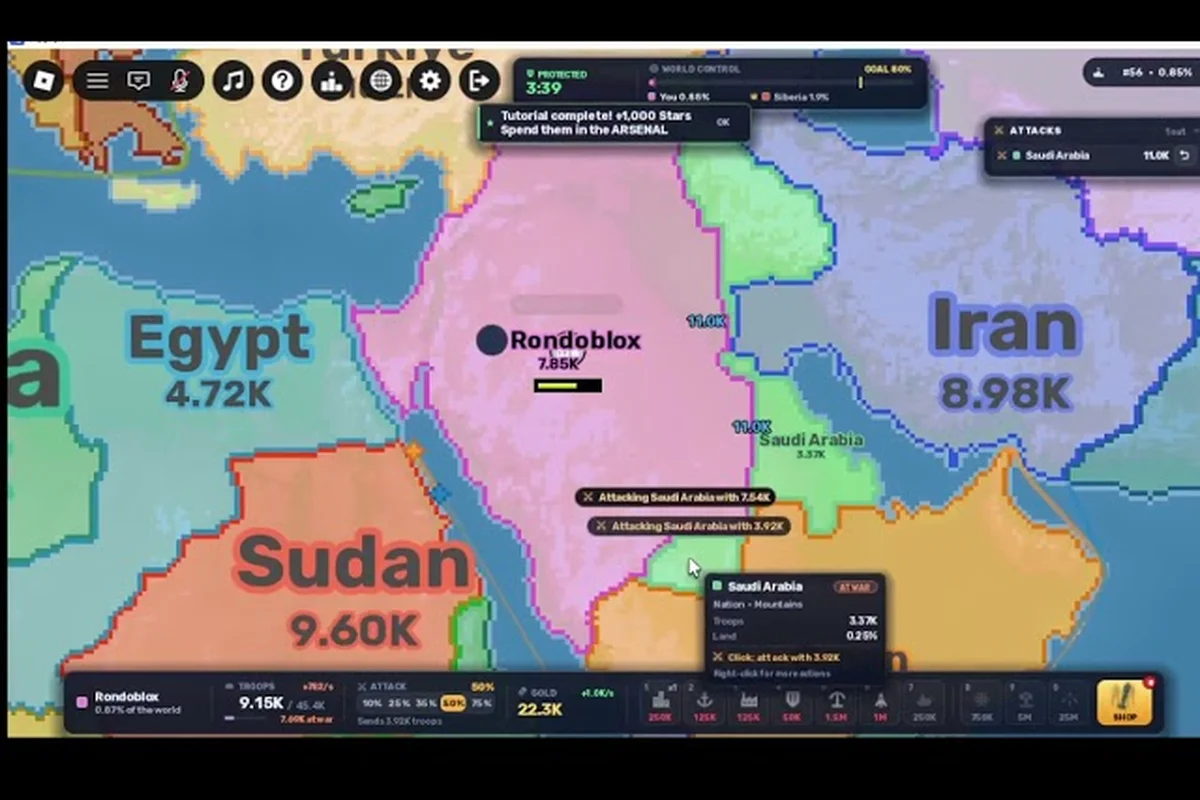
Choosing the right roWorld abstract map can determine whether you build a compact, aggressive empire or spread into a wider strategic frontier. Map size changes travel time, capital placement, and the pressure you face from neighboring nations, so understanding those trade-offs is essential before the match begins.
Detailed guidance for constructing the roWorld abstract map can be found in the RoFront beginner guide community video.
RoWorld Abstract Map Basics and Strategic Value
The roWorld abstract map replaces a realistic country layout with a simplified board designed around strategic movement. Instead of comparing familiar borders, players must interpret connected territories, coastlines, routes, and starting positions. This makes geography less decorative and more tactical, especially when the roster mixes conventional nations with communities built around a shared human identity.
The official Roblox page describes a large multiplayer world where 88 player nations and hundreds of tribes share the map, with servers supporting up to 55 players. The stated victory condition involves controlling 80% of the world, while cities, ports, factories, alliances, and nuclear weapons form the broader strategic toolkit. These details matter because a small board compresses the journey from first settlement to a decisive territorial majority.
| Feature | Small abstract board | Large abstract board |
|---|---|---|
| Early travel pressure | Shorter distances create frequent contact | More space allows deliberate expansion |
| Capital placement | Safer inside a compact cluster | More viable away from dense centers |
| Typical strategic rhythm | Secure nearby land, then pressure rivals | Build the economy, then connect distant holdings |
| Main danger | Quick encirclement | Slow consolidation and divided attention |
| Best planning focus | Chokepoints and neighboring borders | Transport routes and development order |
This table deliberately avoids unofficial cost, troop, or income figures. RoWorld has not published those values, so the most reliable map advice comes from board geometry, available structures, player behavior, and official victory conditions. The official game page also credits OpenFront and its contributors as the upstream project that Snick adapted, which explains why territorial control and economic development sit at the center of the experience.
Abstract geography does not mean every board plays identically. Two maps can have similar square dimensions while producing different outcomes because the distribution of coastlines, land corridors, and spawn areas changes where pressure originates. Players should therefore treat the roWorld map size as a starting clue, not a complete forecast.
RoWorld Map Selection Guide: Reading the Board
A useful roWorld map selection guide begins with the route from your chosen nation’s spawn area. Do not look only for open land; examine where a capital can sit, what it can connect to, and which neighboring territories can reach it quickly. On a compact board, a capital with several land approaches may be valuable for defense, while a coastal capital may provide port options and alternative movement.
Coastal and Inland Positions
Coastal capitals offer a distinct strategic profile because their borders touch both land and water. That can make them easier to defend against a single land approach, but it may also place them near sea routes and larger players. Inland capitals can offer a broader network of land connections, although they can become trapped when nearby neighbors control the surrounding corridors.
| Capital position | Immediate benefit | Strategic risk | Best early objective |
|---|---|---|---|
| Coastal | Access to a port and water route | Exposure to sea pressure and naval competition | Connect ports while protecting the inland side |
| Inland | Direct access to surrounding land | Fewer escape routes if borders close | Secure nearby corridors and nearby resources |
| Corner | Natural protection from some approaches | Easy containment when land is taken | Develop the safe side before overextending |
| Central | Access to several directions | Exposure on many fronts | Form a compact block with dependable links |
The table focuses on structural advantages rather than hidden numerical multipliers. A capital’s practical value also depends on which nation you chose and how that choice affects your opening position. If you are still comparing countries before launch, the roWorld nation selection overview can help narrow the decision by nation type and starting footprint.
Distance, Borders, and Chokepoints
Distance is not a fixed statistic in an abstract board; it is a visual relationship between territories. Count the number of land crossings, assess the shape of corridors, and notice whether your capital can expand toward several useful destinations. A position that looks spacious on a large map may still be dangerous if every route passes through a single narrow junction.
One shared border can be safer than several exposed ones when the neighboring player is already expanding aggressively. Conversely, a capital with multiple borders may have better development options if those neighbors are distant, peaceful, or willing to cooperate. The key is to compare the map’s geometry with the behavior visible in the server.
A practical scouting checklist includes the following: count the land crossings from each capital, classify each neighboring border as direct, coastal, or corridor-based, and note whether the surrounding territories offer independent access to resources. A capital with two land crossings and a protected coastal edge is less vulnerable than one whose visible expansion space narrows to a single passable junction, especially when rivals control both ends of that corridor.
-
Identify the nearest capital in each direction before committing to expansion.
-
Check whether open land connects directly or requires passing through another territory.
-
Mark ports and coastal approaches as separate pressure routes.
-
Observe whether players are expanding immediately or building up their starting region.
-
Avoid placing every early objective in one direction, especially on a small board.
-
Preserve a second expansion route before rivals close the first.
These observations make the roWorld humans vs nations format easier to read. When many human-controlled players begin close together, the first meaningful objective may be survival through local cooperation. When those communities occupy more space, the match can shift toward border management and slower consolidation. For broader board coverage, the roWorld map guide explains how maps differ in scale and naming.
RoWorld Small Map Strategy: Close-Range Competition
RoWorld small map strategy is built around compressed decision time. A short route that takes several minutes on a large board may be completed almost immediately here, meaning neighbors can interfere with expansion before your economy has settled. The central challenge is not simply taking more land; it is preventing rivals from boxing you in while your capital and local structures are still developing.
Build a Compact Starting Block
A small board rewards a coherent block of territory. Start by securing the land immediately around the capital, then connect that position to one dependable neighbor. This creates a defensible core while leaving at least one route for a second wave of expansion. A scattered chain of isolated tiles may look larger, but it is usually more vulnerable when opponents can pressure one connection at a time.
| Early priority | Reason | Preferred approach |
|---|---|---|
| Capital security | Prevents immediate containment | Improve the core before distant expansion |
| Nearby connection | Makes territory easier to defend | Claim a compact neighboring zone |
| One alternate route | Reduces the chance of a total blockade | Develop a second corridor early |
| Local resource access | Supports continued development | Balance usefulness against exposure |
| Neighbor monitoring | Reveals imminent threats | Observe movement before committing away |
Because exact building costs, income rates, and attack modifiers are not published, development order matters more than memorized numbers. A player who spends everything on distant expansion can leave the starting capital defenseless, while a player who never expands may surrender the map’s valuable percentage. The practical middle ground is to create a strong local core, secure a second connection, and only then push outward.
Use Aggression Selectively
Aggression on a small map is not the same as attacking constantly. Because contact is frequent, a short disruption can delay a nearby rival’s development, but an extended fight can pull attention away from open land. The better opening is often to pressure the weakest exposed border while reinforcing your own capital and internal connections.
Opportunistic expansion also limits the danger of a two-front conflict. If two neighbors are already contesting the same corridor, forcing a third front may be unnecessary; take an uncontested territory instead. Watch patterns rather than labels. A player with a large nation may still be distracted, while a smaller neighboring player may be expanding faster than expected.
Do not assume that a large nation must control all central space. On a compact board, an alliance can protect your rear while you take a flank. Conversely, a small nation with favorable terrain may be more dangerous than its size suggests. The roWorld best strategy tier list is useful for comparing broad strategic approaches, but map position remains the decisive local variable.
Survive the Human Majority
In roWorld humans vs Nations matches, human communities can dominate the board numerically. If your faction represents human players while the other side includes conventional nations, your early plan should emphasize coordination and avoiding isolated confrontations. A human player surrounded by several nation players may find it difficult to defend every capital, even if each opponent is individually manageable.
| Human-majority problem | Why it occurs | Practical response |
|---|---|---|
| Split expansion | Each player protects a different direction | Establish a shared center and agreed growth order |
| Duplicate construction | Several players chase the same nearby land | Assign complementary expansion lanes |
| Delayed response | News travels slowly across the map | Keep a visible rally point for urgent support |
| Overextended borders | Players expand at unequal speeds | Favor compact growth before distant claims |
| Internal friction | Separate goals emerge among players | Focus on shared defense and local objectives |
The best human strategy depends partly on trust and communication, but the board still provides useful structure. Shared capital space, mutual borders, and common threats can make a compact coalition more resilient than isolated land grabs. The crucial point is to preserve a defensive arrangement before each player takes a distant objective.
RoWorld Large Map Strategy: Expansion and Consolidation
RoWorld large map strategy centers on sequencing. There is more physical room, so a player can protect a developing core while building toward a port, another capital, or a distant resource zone. The danger is not immediate contact alone; it is that distant claims divide your attention while a closer rival grows stronger.
Establish a Development Ladder
Use the large board to create connected stages rather than scattered objectives. A reliable ladder begins with the capital’s immediate area, expands to nearby supporting territory, reaches a strategic route or port, and only then links to remote holdings. Every stage should strengthen the next one.
| Stage | Main objective | Reason for priority |
|---|---|---|
| Core | Stabilize the capital and its closest territory | Creates a dependable foundation |
| Local network | Connect nearby land and support structures | Improves control without a long journey |
| Strategic link | Reach a port, corridor, or useful coastline | Connects later expansion routes |
| Regional reach | Claim a distant but supportable area | Adds room without abandoning the core |
| Consolidation | Link all holdings and remove isolated risks | Prevents enemies from splitting the empire |
Geographic patience is valuable because travel time gives both sides room to react. However, waiting too long can allow another player to become the regional leader and close routes before you arrive. Watch distant activity just as carefully as immediate borders, especially when a large group moves toward the same port or narrow passage.
Balance Expansion and Defense
On a large board, a new player may make too many claims too quickly, spreading structures and attention across the map. Prioritize holdings that improve network efficiency: a tile that links two developed areas is often more valuable than an isolated tile with a dramatic position. Strong expansion should reduce the effort required to manage the whole empire.
Large maps also create opportunities for specialization. A player with a protected inland core may focus on cities and factories, while another develops ports and coastal connections. These are player-created strategies rather than official role requirements, so the board’s features and the surrounding competition must determine which approach fits.
| Expansion approach | Strength | Main weakness | Best condition |
|---|---|---|---|
| Wide spread | More land and flexible options | Difficult defense and long links | Strong allies and safe central position |
| Compact growth | Easier to defend | Less room for rivals to bypass | Stable local environment |
| Coastal chain | Connects ports and water routes | Exposure at several sea edges | Control of nearby sea approaches |
| Inland network | Strong land connectivity | Can be cut off by chokepoints | Broad neighboring territory |
| Spearhead claim | Surprises less-prepared rivals | Creates an isolated exposed flank | Support ready to reinforce it |
For example, a large nation should compare the value of a distant claim with the security of its central territory. A compact homeland that supports a smaller frontier may be more valuable than a scattered collection of disconnected holdings. The roWorld large nation strategy overview provides a useful framework for weighing territorial reach against administrative and defensive pressure.
Choosing Between Small and Large Map Sizes
RoWorld map size affects the entire rhythm of a match, but the correct choice depends on your preferred contest. Small maps emphasize immediate competition, compact capitals, and fast reactions. Large maps reward planning, network building, and coordinated expansion across a wider area. Neither size is universally easier because each shifts pressure to a different phase.
| Player preference | Better map fit | Advantages | Main challenge |
|---|---|---|---|
| Fast conflict and territorial play | Small | Short travel and clear rivals | Early containment risk |
| Patient development | Large | More room to build and route | Slow consolidation |
| Coordinated team play | Both | Shared capital and regional plans | Agreement across many players |
| Solitary territorial control | Small | Easier to see every threat | Multiple neighbors can pressure one player |
| Alliance-driven expansion | Large | Separate lanes can be assigned | Long-range reinforcement |
| Defensive capital focus | Small | Borders are easier to monitor | Little room for a failed opening |
Map selection is also a prediction of player behavior. On a small board, a human-majority lobby may produce intense early clashes because there is nowhere to hide. On a larger board, groups can form more distinct regional clusters, but a large cluster may become easier for a coordinated nation to pressure. Consider the lobby composition and the visible early movements before committing.
A Practical Decision Sequence
When comparing roWorld abstract maps, treat board size as a strategic constraint rather than a difficulty setting: a small map compresses capital adjacency, shortens early encounters, and makes isolated human settlements harder to defend, while a larger map spreads the same starting resources across more territory and creates longer expansion corridors. Because map scale changes how quickly nations can pressure one another, the best choice depends on whether the intended roWorld humans vs nations session emphasizes close human coordination or sustained regional development.
-
Identify your desired tempo. Choose a small board for quick competition or a large board for a longer territorial project.
-
Check the available starting positions. Look for a capital with enough neighboring land or strategic routes to support the intended style.
-
Observe the nearest threats. A distant rival can be less relevant than a player already expanding toward your corridor.
-
Evaluate your cooperation needs. Human communities benefit from compact, shared arrangements on small boards and clearer regional responsibilities on large ones.
-
Test the exit route. Make sure your starting region is not dependent on one border that an opponent can occupy early.
-
Set a first expansion target. A useful target should connect with existing territory rather than create an isolated outpost.
-
Reserve a second direction. Flexibility is valuable even when the first route is open.
-
Review the map after the opening. Adapt if players establish an unexpected regional power or close a previously open passage.
This process turns a visual preference into a defensible plan for the roWorld abstract map by tying board size to concrete positional consequences. A compact board may look crowded, yet it can place capitals, resource access, and early expansion routes within immediate interaction range; that compression raises pressure on human coordination and makes overextension costly. A large board may promise more apparent freedom, but greater distances can delay contact while increasing the cost of securing border regions. The practical test is therefore not whether the map “looks” spacious, but whether its capital adjacency, starting positions, and exit routes support the intended roWorld humans vs nations tempo without making early regional development too fragile.
Abstract Map Archetypes and Match-Style Signals
Different abstract maps create different strategic situations, even when their overall dimensions are similar. A board built around several narrow land connections produces a contest over corridors. A board dominated by open territories encourages faster outward expansion. A coastal layout adds port and crossing decisions. A tightly packed human start creates a different political problem from a map where players are dispersed across distant regions.
| Map signal | What it rewards | What to avoid |
|---|---|---|
| Several narrow corridors | Holding chokepoints and timed expansion | Building a fragile chain around one passage |
| Wide open interior | Rapid land claims and broad economy focus | Leaving the capital without a backup connection |
| Concentrated spawns | Alliance, compact defense, quick coordination | Scattered goals with no shared center |
| Dispersed spawns | Regional independence and longer planning | Assuming distant help will arrive quickly |
| Numerous coastlines | Port development and route management | Treating every port as equally valuable |
| Dense central region | Political influence and early competition | Expanding outward before local security |
The Humans vs Nations distinction is most visible when human players begin near one another. Multiple communities may occupy the same crowded region, making cooperation beneficial but also creating overlapping claims. By contrast, humans spread among conventional nations may be better served by self-contained expansion and careful diplomacy. Neither case is fixed, because players can alter the layout through early movement and alliances.
A reliable map-reading routine is to look at the capitals before studying the empty land. Empty tiles represent opportunities, but capitals determine the actual political landscape. Note which groups are close, where alliances might form, and whether a region has several possible paths into the center. Then compare those observations with the map’s boundary shape.
Align the Nation with the Geography
Some nation choices fit particular spaces more comfortably. A large nation may benefit from a roomy interior where it can develop a broad core, while a smaller nation may gain value from a coastline or compact enclave. Geography does not determine the outcome, however, because player count, neighbors, and timing often matter more than the nation label itself.
| Geography condition | Nation-type tendency | Strategic angle |
|---|---|---|
| Broad inland space | Large nation | Build a wide support base |
| Numerous compact regions | Smaller nation | Specialize and protect a local core |
| Coastal route | Port-oriented nation | Connect maritime and land positions |
| Isolated outer region | Flexible nation | Develop economy before seeking contact |
| Dense central contest | Strong local fighter | Secure nearby territory early |
This table reflects player experience patterns, not official country modifiers. There are no published RoWorld numbers for building costs, income, troop strength, or attack percentages, so it would be misleading to claim that one nation receives a hidden map bonus. The safer conclusion is that capital placement and neighboring relationships alter the practical value of a nation’s footprint.
Practical Match Preparation Checklist
Preparation should focus on decisions that remain useful across small and large boards. Review the map after spawning, identify the local pressure, and choose a development order before claiming distant territory. The official Torrey Pines Roblox group is the verified community channel for RoWorld, and it is the best place to confirm any future official communication, although current patch and balance details should be treated cautiously unless published on the game page.
| Preparation stage | Small-map focus | Large-map focus |
|---|---|---|
| First minute | Locate every nearby capital | Map the nearest major routes |
| Early development | Build a compact connected core | Create a staged development ladder |
| First expansion | Choose one urgent nearby target | Reach a strategic connection |
| Mid-match | Watch for encirclement | Prevent distant holdings from isolating |
| Late match | Eliminate rival blocks | Consolidate scattered territories |
| Final contest | Control key junctions | Link regional holdings and cover gaps |
Avoid unsupported claims about exact timings, because server pace and player decisions vary. Instead, watch the actual round. If neighboring capitals are rapidly filling empty land, compress your own timeline. If players are building in isolation, use that quieter phase to secure a distant route before the board fills.
Three-point adaptation rule is useful when a plan breaks down. First, preserve the capital and your strongest connection. Second, reassess the nearest threat rather than the largest territory on the map. Third, redirect toward an open, strategically useful area. This process works for both aggressive small-board play and long-range large-board expansion.
Before entering another match, the best roWorld abstract map choice is the one that matches your available attention, alliance structure, and preferred pace. Small maps make neighboring interactions immediate; large maps make geographic sequencing equally important. In either case, inspect capitals, protect connected territory, and respond to the board players actually create rather than relying on a fixed build order.
Frequently Asked Questions
Is a small or large roWorld abstract map better for beginners?
A small map is usually easier to understand because fewer territories are in play, and your capital’s neighbors are easy to identify. However, it also creates faster pressure and fewer safe expansion routes. A large map allows more planning but demands better route awareness, stronger development sequencing, and an ability to monitor distant threats without abandoning the core.
What is the best capital position on a roWorld abstract map?
The best position connects to several useful areas while limiting immediate encirclement. A coastal capital can offer a port and alternate water route, while an inland capital may have more direct land connections. Corner positions can be safer but risk containment. Always check neighboring capitals, since the board’s geometry matters more than any unconfirmed numerical bonus.
Should human players cooperate in the roWorld humans vs Nations format?
Cooperation is often useful when human-controlled communities begin close together, because a shared center and complementary expansion lanes can prevent local rivals from isolating individuals. If humans are scattered across the board, self-sufficient expansion may be easier. Alliance strength depends on shared goals, communication, and whether players are willing to support one another before borders become contested.
How does roWorld map size affect early expansion?
Small maps shorten the time between starting capitals and distant objectives, making neighbors more likely to interfere with early claims. Large maps create more room, but a distant target may consume considerable travel and development time. On either size, secure the capital, establish at least one dependable connection, and choose a second route before relying on isolated expansion.
Are official map stats available for RoWorld?
The official Roblox page confirms the broad multiplayer structure, including 88 player nations, hundreds of tribes, servers of up to 55 players, and an 80% control objective. It does not publish detailed map dimensions, building costs, income rates, troop multipliers, or attack percentages. Map advice should therefore rely on official feature lists, visible board geometry, and clearly labeled community observations.