
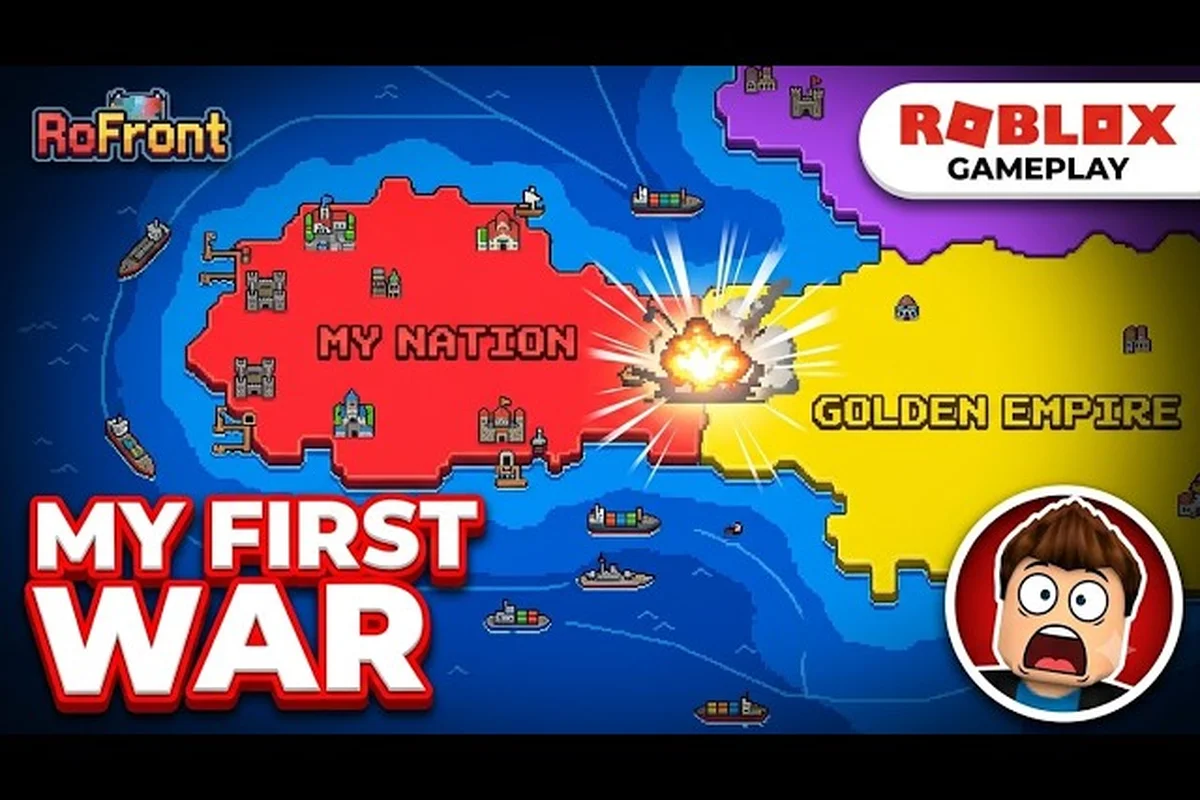
A successful roWorld large nation strategy depends on protecting income before chasing more land. Because 88 player nations compete across each board, broad expansion only works when borders, economy, and defense remain synchronized. In practice, a large nation should expand along one defensible axis at a time, preserve a reserve for fortification and resource income, and avoid overcommitting to a second front. This matters for landlocked nations especially: without direct coastline access, controlling trade routes and internal infrastructure can provide the economic stability needed to survive pressure from neighboring large nations.
Why Large roWorld Nations Need a Different Expansion Plan
Large nations in RoWorld do not have a shortage of potential territory. They have a coordination problem. Every new border creates another route through which an opponent can test your defense, while every distant city or port demands attention that may be unavailable when the capital is under pressure. The official RoWorld game page on Roblox identifies cities, ports, factories, alliances, and nuclear weapons as core features, but it does not publish fixed income, cost, or combat values. Every plan must therefore be evaluated through positioning and decision order rather than invented numbers.
The official listing also confirms that the board includes 88 player nations alongside hundreds of tribes, with a server supporting as many as 55 players and a victory objective based on controlling 80% of the world. Those facts make early coordination more important than grabbing the nearest territory automatically. A major nation can have several viable openings, but it also has more borders to monitor and more systems to keep from competing for attention.
A practical roWorld nation strategy begins with three resources that cannot be replaced instantly: connected territory, dependable income, and combat readiness. A large player that loses any one of them may remain geographically impressive while becoming strategically brittle. This is why the best large-nation plan is a sequence of controlled commitments rather than a list of attractive targets.
| Large-nation pressure | Early symptom | Corrective decision |
|---|---|---|
| Borders spread too quickly | Troops and attention are always stretched | Consolidate before claiming more land |
| Cities become scattered | Income stops supporting the next expansion | Build a connected economic network |
| Ports expand without purpose | Naval threats arrive from several directions | Secure one useful coastal corridor |
| Alliances create obligations | Defensive requests consume the reserve | Limit commitments to clear, bounded roles |
| Nuclear spending rises | Ordinary defenses feel neglected | Preserve a conventional defensive core |
The central principle is simple: land is an input, not the score. Territory supports the economy, economy supports the military, and the military makes additional territory defensible. If one link breaks, large-nation expansion can look successful on the map while creating a nation that is difficult to supply or defend.
For a broader look at how the board shapes your options, the RoWorld abstract map guide explains why map size and route geometry can matter more than a generic nation ranking. In the 88-player-nation format, a large nation should compare practical corridors rather than distant targets: a short land bridge to a factory may strengthen connected territory, while a longer route to a port may expose factories, cities, and borders to separate threats. That route comparison also clarifies whether a landlocked core or an island nation can support a controlled expansion sequence.
Choosing a Capital That Can Anchor Broad Expansion
The capital of a large nation should function as an administrative and economic anchor rather than merely a convenient first tile. Its location determines where your initial network grows, which neighbors remain exposed, and how easily troops can move between important areas. A central position can support several routes, but a coastal capital may offer better port access. Neither is automatically superior because the neighboring land shapes matter.
Before settling on an opening, identify the surrounding geography. Count usable land approaches, note the distance to the nearest coast, and observe which territories are already occupied or constrained. A capital with several approaches can become a strong transport hub, yet it may also sit where two hostile powers can apply pressure at once. A coastal location may narrow the land frontier, giving a large nation fewer defensive avenues while opening naval possibilities.
The best choice is the one that supports a defensible economic spine while preserving at least one safe growth direction. Avoid selecting a capital merely because it touches several empty spaces. Empty land can become a broad but unsupported extension. Instead, favor a location from which you can connect your first city, a useful factory area, and a reachable border without crossing the most dangerous neighbor.
| Capital position | Main advantage | Main risk | Best use |
|---|---|---|---|
| Central inland | Supports multiple land routes | Can be pressured from several directions | Connected city and factory network |
| Coastal interior | Combines land access with port planning | Navy and land threats may overlap | Balanced land-and-sea expansion |
| Coastal edge | Strong port and transport potential | Narrow land defense and exposed coast | Early naval infrastructure |
| Island or island-adjacent | Natural separation from many rivals | Fewer land connections | Controlled island base and sea lanes |
| Landlocked interior | Harder for naval powers to isolate | Can be boxed in by stronger neighbors | Dense economic growth and diplomacy |
This comparison is qualitative because RoWorld does not publish nation modifiers, border bonuses, or income formulas. Players should treat geography as the reliable basis for comparison. When choosing among starts, the RoWorld nation list can help identify the role you want, but the neighboring land in the current server matters more than a universal hierarchy.
Establishing the first economic corridor
After placing the capital, prioritize territory that links practical destinations. A useful corridor might connect a city to a factory, a port to an inland city, or a defensive position to a transport route. The goal is not merely to own connected tiles. It is to create a chain in which captured land improves production, movement, or security.
Apply this order for early large-nation expansion: secure the capital’s immediate approach, connect the first dependable income source, establish a production connection that can support later growth, add one border strong enough to deter opportunistic attacks, and only then consider a second expansion direction. For example, a large nation should first link its capital to a nearby port or factory, then reinforce that route before extending toward a distant territory; this sequence keeps movement, production, and defense aligned while avoiding the instability of pursuing multiple fronts at once.
-
Secure the capital’s immediate approach.
-
Connect the first dependable income source.
-
Establish a production connection that can support later growth.
-
Add one border strong enough to deter opportunistic attacks.
-
Only then consider a second expansion direction.
Avoid competing priorities at the same time. If your capital is threatened, do not simultaneously build a distant port. If income is weak, do not recruit beyond what the treasury can sustain. Large nations lose more from a broken sequence than from a modest delay.
Managing roWorld Island Nation and Landlocked Expansion Paths
Geographic isolation changes the structure of a large-nation plan. A roWorld island nation may have fewer land approaches, making land defense easier in some directions while making coastal access, transport, and naval warning much more important. A roWorld landlocked nation faces the opposite problem: its economy can expand through connected territory, but it has fewer ways to project power or trade pressure outward.
Both strategic approaches work only when infrastructure matches their operational role. A roWorld island nation should prioritize secure coastal connections, shipping capacity, and warning of threatened sea routes, because a single blocked port can interrupt the landing-area system that links its cities and factories. A roWorld landlocked nation should instead develop dense connected city and factory networks while protecting the land bottlenecks that prevent neighboring powers from sealing its access routes. The central mistake is treating an island like a landlocked power, or expecting inland territory to substitute for a port corridor’s maritime functions.
| Expansion condition | Island approach | Landlocked approach |
|---|---|---|
| Primary vulnerability | Blocked or threatened sea routes | Encirclement and land bottlenecks |
| Best early growth | Controlled coastal connections and secure transport | Dense connected city and factory network |
| Main diplomatic need | Avoid enemies controlling nearby landing areas | Prevent neighbors from sealing access routes |
| Strategic advantage | Natural separation from some rivals | Protection from naval invasion |
| Strategic limitation | Dependence on ports, ships, and coastal security | Few direct maritime options |
Island expansion rules
Island players should treat the coast as a sequence of connected military positions. One port is not automatically enough if enemy fleets can operate around it, and isolated ports can create supply lines that invite interdiction. Build a clear defensive understanding around every landing area, then expand inland only when the coastal route remains secure.
An island opening also benefits from deliberate diplomacy. A nearby large nation may be unable to invade directly, but it can pressure allies, threaten trade routes, or prepare a naval invasion. The official Torrey Pines community page is the best verified place to check for game information, while community footage can help observe route choices. Treat those observations as player behavior, not fixed rules.
Landlocked expansion rules
A landlocked nation should prioritize a compact income network and a defensive buffer around the core. Because the official page does not publish per-nation modifiers, the safest path is to use connectivity rather than assuming any country is inherently stronger. Connect cities to factories, avoid leaving key production centers exposed, and secure routes for troop movement.
Do not expand until the interior is stable. A broad landlocked empire with disconnected resources may be less valuable than a smaller network whose production supports the military consistently. In practice, strong landlocked players negotiate for access and maintain enough conventional strength to discourage encirclement.
Expanding Borders Without Outrunning the Military
Large-nation expansion is a supply problem before it is a conquest problem. Each additional front can divide attention, create a longer troop route, and increase the number of targets an opponent can test. A disciplined player captures only what the existing economy and military can support.
The five-front test
Before claiming territory, check five conditions: income continuity, movement, defense depth, enemy access, and strategic value. For a large nation, treat them as linked constraints rather than a shopping list: a coastal corridor may improve access to ports and sea routes, but it also creates a vulnerable flank; a distant resource-rich interior may strengthen the economy, yet its long supply lines can pull attention away from a more dangerous border. A capital-adjacent expansion with strong support is usually safer, but nearby rivals may react sooner, so the timing of consolidation and negotiation matters as much as the land’s apparent value.
-
Income continuity: The new territory should strengthen or protect the economic core rather than create a remote pocket.
-
Movement: Troops must be able to reach the front without abandoning a more dangerous border.
-
Defense depth: The outermost position should have warning time and support behind it.
-
Enemy access: Count the routes through which a hostile nation can reach the new area.
-
Strategic value: The land should protect infrastructure, deny a useful route, or create a durable connection.
If two or more answers are uncertain, the expansion is probably premature. This is especially relevant when a large nation faces several moderate players. One opponent may be manageable, but coordinated pressure across separate borders is much harder to answer.
| Expansion choice | Immediate benefit | Hidden cost | Preferred timing |
|---|---|---|---|
| Take neutral land near the capital | Strong support and visibility | May provoke nearby rivals | Early consolidation |
| Capture a coastal corridor | Access to ports and sea routes | Adds a vulnerable flank | After naval defense is ready |
| Attack through an ally’s territory | Shorter strategic path | Creates diplomatic and supply risk | With explicit coordination |
| Push a distant enemy border | Reduces one opponent’s space | Long supply lines and distraction | When other fronts are stable |
| Expand into a resource-rich interior | Supports durable income | Requires a secure connection | During a controlled mid-match phase |
Community gameplay observations show a recurring sequence: choose a start, place a capital, expand into available land, establish economy, then negotiate or fight as neighbors emerge. This loop is a useful play pattern, not a guaranteed script. A large nation can interrupt it by consolidating earlier and creating a more coherent network.
The best-strategy tier list reference can help frame the roles available in the current meta, but it should not replace match-specific evaluation. A seemingly strong strategy fails if it requires several simultaneous fronts and no reserve.
Maintain a reserve before taking another border
A reserve is the portion of your military posture that is not assigned to visible front-line duties. Its exact size cannot be given responsibly because the game publishes no universal troop or upkeep figures. The practical test is whether one emergency can be handled without abandoning another border.
Before approving an expansion, ask whether the new border forces a permanent change in your nation’s military posture. A large nation should avoid assigning every available troop to its outermost settlements; keep a strategic reserve capable of responding to a surprise attack elsewhere, and define in advance whether that reserve can be released without exposing an interior settlement. For example, if the expansion depends on a distant network, compare the cost of reinforcing its outermost settlement with the risk of leaving a second border undefended. A defensible expansion improves long-term network control, not merely the number of controlled tiles, and should survive the loss of a forward settlement without consuming the entire national budget and attention.
-
Can the current military posture handle a surprise attack elsewhere?
-
Does the new border create another permanent commitment?
-
Is the objective worth the production and attention it requires?
-
What is the fallback if the attack stalls?
-
Can the network be defended if the outermost settlement falls?
A large nation that always commits its available forces becomes predictable: opponents can identify a thinned border, launch probes, and force a choice between defending the frontier and protecting an interior settlement. A strategic reserve makes that test less reliable by retaining mobile forces for a surprise attack elsewhere. Because roWorld publishes no universal troop or upkeep figures, the reserve cannot be assigned a fixed number; it should instead be defined by the largest simultaneous emergency the nation can absorb without abandoning another border.
Coordinating Cities, Ports, Factories, and Allies
Cities, ports, and factories solve different strategic problems, so a large nation should treat them as linked parts of one expansion network rather than isolated construction projects. A coastal port is valuable only when naval defense and inland transport can protect its trade route; factories become a durable military asset when their output reaches defended troop corridors, while cities supply settlement and manpower. Connecting these systems reduces the number of exposed objectives, but spreading them faster than defense can follow creates multiple fronts that demand constant reinforcement.
Cities anchor settlement and provide the natural base for surrounding expansion. Ports extend your reach toward coastal routes and transport operations, although they also require naval attention. Factories support military production, making their security directly connected to the future size of your army. The official game page confirms the presence of all three systems, while community reports continue to discuss their practical roles.
| Building type | Strategic job | Placement priority | Common large-nation error |
|---|---|---|---|
| City | Expand and anchor territory | Near a connected growth corridor | Scattering cities faster than defense can follow |
| Port | Support transport and coastal access | Along a controlled coastal route | Building where sea routes are already exposed |
| Factory | Sustain military production | Behind protected land or a secure network | Leaving production away from the troop network |
| Defense post | Delay or discourage attacks | Near likely approaches and useful terrain | Covering every border equally instead of likely threats |
| Nuclear deterrent | Shape extreme strategic decisions | Only after a conventional foundation exists | Spending prestige while basic security is weak |
Match buildings to network roles
Start by assigning each network a role. One cluster may be the production heartland, another the coastal operations base, and a third the forward border position. Then ask whether a realistic enemy attack would force you to abandon one role to protect another. If so, the network needs another connection or a defensive priority.
For a roWorld landlocked nation, factories and cities should usually form the central system because maritime access is limited. For a roWorld island nation, the port and transport network deserve earlier attention because each coastal position can carry more strategic weight. These are planning rules rather than fixed build orders, and they remain valid even though RoWorld has not published official construction costs.
| Priority | Large mainland nation | Large island nation |
|---|---|---|
| First | Connected city and factory core | Secure capital and coastal access |
| Second | Border defense and interior growth | Port security and transport route |
| Third | Coastal expansion if strategically useful | Land connections to nearby islands or coasts |
| Later | Additional production and forward positions | Controlled interior expansion |
Use alliances as bounded tools
An alliance can cover a distant border, create a shared front, or discourage a nearby expansion. It becomes dangerous when the alliance is treated as an unlimited reserve or when obligations are unclear. Define the role each partner plays: defensive support, shared defense, transport assistance, or offensive coordination.
Community reports indicate that clear coordination and a reputation for keeping agreements matter more than alliance size. These observations are not official rules, but they reflect the practical problem: a partner with a specific role is easier to manage than a loose group making conflicting requests.
Keep at least one function under your own control, because alliance support can disappear when priorities, coordination, or regional commitments change. A large nation should maintain an independent defensive plan for each vital area—such as its capital, resource-producing regions, transport corridors, and border provinces—while using alliances to cover distant fronts or deter expansion. If partner obligations are unclear, a shared defense may fail during a multi-front crisis, leaving your nation unable to protect its core territory without outside help.
A Phase-Based Plan for roWorld 88 Nations Competition
Against 88 player nations, broad power attracts attention. A large nation that expands visibly and consistently will encourage tests from weaker neighbors, alliances from threatened states, and counterattacks against overextended borders. A phase-based plan prevents every pressure point from being addressed at the same time.
Early game: build one dependable core
During the opening, resist dividing attention across several unrelated regions. Establish a capital, secure a connected territory, and choose the infrastructure that supports your intended large-nation role. A coastal empire needs a secure approach to the sea, while a landlocked empire needs interior production depth and dependable land routes.
The early goal is not maximum territory. It is a territory that can produce, move troops, and survive one unexpected attack. If your capital has several approaches, protect them in order of likely threat rather than spreading the same defensive attention evenly.
Midgame: choose one clear advantage
The middle phase should create a capability competitors cannot easily ignore. A large coastal nation might develop transport access, a landlocked nation might concentrate production behind narrow approaches, and a geographically central nation might become the transportation hub for its region.
For a large nation, the advantage should be a linked, operational system rather than a single strong unit: a coastal build can pair harbor access with protected sea lanes, while a landlocked build can rely on fortified chokepoints and concentrated production. In the roWorld 88 nations setting, this choice determines which expansion corridor is worth contesting, since a clear strategic advantage forces rivals to respond to your transport network, defensive depth, or regional production hub instead of merely avoiding your borders.
-
Consolidate the economic core.
-
Secure the borders that protect that core.
-
Identify the single expansion that strengthens your chosen advantage.
-
Negotiate where negotiation reduces your defensive burden.
-
Preserve a conventional military reserve before large attacks.
| Match phase | Main goal | Expansion boundary | Military posture |
|---|---|---|---|
| Early game | Create a stable economic core | Connected territory near the capital | Defend the starting region |
| Midgame | Develop one strategic advantage | One carefully chosen expansion corridor | Maintain a reserve |
| Late game | Reduce major opposition and control key routes | Attacks supported by mature networks | Concentrate forces without exposing the core |
| Victory push | Reach the required world control | Coherent contiguous gains | Protect critical infrastructure and reserves |
Late game: prevent external pressure from undoing gains
A large nation near the 80% control objective is not simply a bigger version of an early nation. Its borders are longer, and opponents can exploit distant weakness. Review each external border and identify the single action that would cause serious disruption: capturing a production center, blocking a route, taking a capital, or landing behind the lines.
The final plan should concentrate military power against the most consequential threat while preserving enough security elsewhere to prevent a collapse. Nuclear weapons are listed among the game's features, but their strategic value depends on deterrence and timing. They should not replace a functioning conventional force because a spectacular attack cannot secure an entire border network.
Final audit before committing
Before committing to a major campaign, compare the projected army cap with the current economy, then map how many turns production, movement, and reinforcement would need to support the offensive. For a large nation, this audit is especially important because an apparently strong opening can collapse if a key city, coastal route, or allied border becomes exposed. Check these conditions before acting:
- The economic network supports the intended army size.
- No vital production area depends on one exposed route.
- Allied commitments are clear and bounded.
- A reserve can handle pressure on an unrelated front.
- The target offers more value than the border it may open.
- The retreat route remains usable if the attack fails.
The current meta overview can be useful for checking which openings players are testing, although community observations change quickly. The reliable part of the strategy is the relationship between territory, production, movement, and defense—not a temporary nation label.
Frequently Asked Questions
What is the best approach for a roWorld large nation strategy?
The strongest approach is to build a connected economic core, protect the approaches to it, and expand along one clear strategic advantage at a time. Large nations often fail when they capture territory faster than they can connect, defend, and fund it. A compact foundation is more valuable than scattered holdings that create constant troop and attention demands.
How should a roWorld island nation defend its borders?
An island nation should treat coastal access and transport routes as part of its border system. Secure landing areas, protect important ports, and avoid assuming that separation from land enemies removes the need for naval defense. Nearby powers may also use allies or submarines to apply pressure, so diplomacy and conventional military readiness remain useful even when direct land invasion is difficult.
Can a roWorld landlocked nation still compete with larger powers?
Yes, if it concentrates on connected cities, factories, and defensible land routes. A landlocked player can use interior production to support a disciplined army, negotiate from strength, and punish neighbors who become distracted. Its main danger is enclosure, so preventing several enemies from closing every route is a central priority.
Should large nations expand along coastlines or into the interior?
Choose the route that supports a coherent network and limits the number of exposed fronts. Coastal expansion can improve transport access but adds maritime vulnerability, while interior growth improves territorial depth but may create bottlenecks. A strong plan often uses the interior as the economic core and a limited coastal corridor for strategic mobility rather than treating one route as universally superior.
How do alliances help among roWorld 88 nations?
Alliances can deter expansion, share defensive burdens, and make an attack on one partner risk a wider conflict. Their value depends on clear roles and credible communication, because unclear promises can pull troops away from your own borders. Use the official RoWorld creator community for verified game announcements, and treat community coordination advice as player experience rather than a formal rule.
The defining advantage of a large RoWorld nation is not the number of tiles it owns. It is the ability to connect, fund, move, and defend those tiles as one system. Build the economic core first, control expansion direction, protect reserves, and use geography deliberately so every new border strengthens the network instead of quietly pulling the nation apart.