
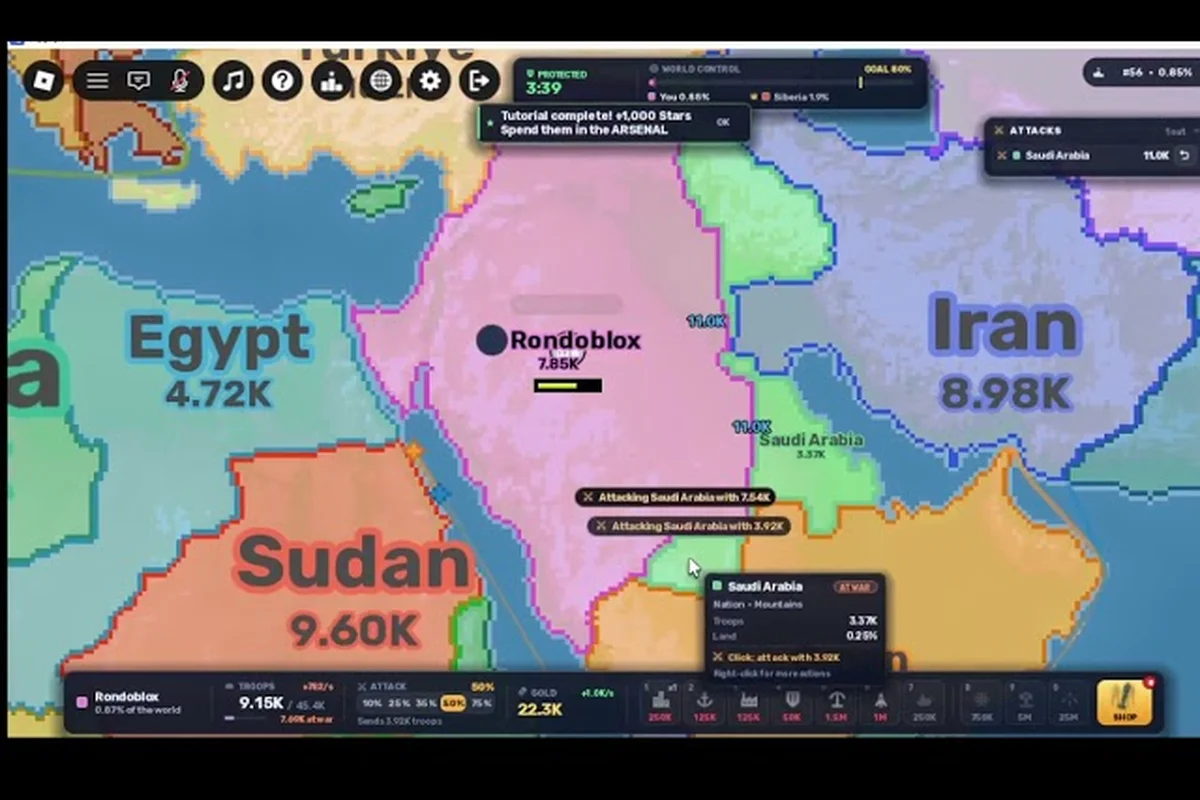
RoWorld map tactics matter because territory is won through positioning, economy, and smart borders—not brute force alone. A strong roWorld map guide for beginners should compare chokepoint layouts, capital placement, and opening routes rather than treat every roWorld map the same. For example, secure a narrow passage before expanding for resources, then use that border as protection for farms and trade routes. In roWorld hv n mode, the opening plan may need to shift toward faster expansion or earlier defensive positioning, so check how the mode changes map control before committing your capital.
Check the RoFront beginner guide community video for the relevant data, mechanics, and tactical guidance.
How roWorld Map Tactics Shape Every Match
RoWorld is a territory-control game where the map is not just the battlefield; it is the foundation of every decision you make. The official Roblox page lists cities, ports, factories, alliances, and nuclear weapons as core features, while the game’s stated objective is to control 80% of the world. That means a player who wins several isolated battles but stretches supplies too thin may still lose the match.
A reliable approach starts with reading geography, identifying neighbors, and choosing a capital that supports a coherent expansion plan. The best roWorld maps for a new player are not necessarily the largest ones. They are the maps where terrain creates useful bottlenecks, safe routes, and clear stages of growth.
| Match factor | What to examine | Tactical effect |
|---|---|---|
| Capital position | Distance to nearby land, sea routes, and resources | Determines how safely you can grow |
| Number of neighbors | Adjacent nations and open borders | Influences early defensive priorities |
| Chokepoint shape | Narrow land passage or controlled crossing | Can reduce how many fronts you must guard |
| Coastline | Open sea, protected bay, or island position | Affects access to ports and expansion routes |
| Available space | Nearby unclaimed territory | Determines whether expansion can be self-sustaining |
The opening sequence that matters
A strong opening has a clear order of operations. First, choose a nation whose position fits your preferred route. Second, place the capital where you can protect early expansion without cutting yourself off from the center of the action. Third, secure nearby territory before making a long move. Fourth, use the economy to support the next border. Fifth, attack when the target is exposed or when a chokepoint gives you a local advantage.
This sequence is more reliable than rushing the nearest opponent. A compact beginning lets you build a functional base, learn the map, and create several possible expansion paths. It also prevents a common beginner mistake: capturing a distant capital while losing the land that connects it to the rest of your nation.
| Stage | Primary goal | Common mistake |
|---|---|---|
| Select nation | Match national position to a route | Choosing by appearance alone |
| Place capital | Create a defensible, connected base | Spawning next to a vulnerable border |
| Expand locally | Gain adjacent, usable territory | Jumping across the map |
| Build economy | Support troops, cities, and infrastructure | Ignoring income and upkeep |
| Push outward | Exploit a weak neighbor or bottleneck | Attacking on several fronts |
The map-specific advice in the roWorld map guide can help you identify different map structures before you commit to a route. What matters is the relationship between your capital and those structures, not simply memorizing a map name.
Reading roWorld Chokepoints and Borders
Chokepoints are valuable because they concentrate movement. A narrow corridor can force several enemies to approach through the same area, while a port or sea crossing can become a similarly important gateway. You do not need an official list of chokepoints to use them; identify the geometry yourself and decide which routes you can deny, contest, or bypass.
Land chokepoints versus sea crossings
A land chokepoint is most useful when it connects a small opening to a larger region. Controlling it may let you protect one front while another part of your nation develops elsewhere. A sea crossing is different because ports and coastal access can influence movement, but it also requires stronger infrastructure and a dependable economy. Treating a port like a land bottleneck can leave you vulnerable if your economy is not ready.
| Chokepoint type | Main advantage | Main risk | Best use |
|---|---|---|---|
| Narrow land corridor | Funnels several routes into one | Can become a trap if flanked | Defensive anchor and staged expansion |
| Coastal access | Supports port-based movement | Requires economy and infrastructure | Connecting separated expansion fronts |
| Island or bridge position | Controls movement between regions | Hard to reinforce if supply is weak | Early isolation or defensive buffer |
| Open border | Offers flexible attack options | Hard to monitor or defend | Opportunistic strike, not first priority |
The best roWorld chokepoints are not automatically the best capitals. A capital needs room to develop, whereas a chokepoint may work best as a secondary objective. If you place your capital directly inside a narrow passage, you may gain control of a valuable route but lose the space required to build a balanced nation.
Count your exposed borders
Every adjacent nation represents another possible front. While exact map layouts differ, you can judge pressure by counting reachable borders and asking who can reach you easily. Two manageable neighbors may be better than four distant rivals who can all pressure the same weak sector. The number of borders matters less than their accessibility, timing, and ability to reach your capital.
| Border condition | Strategic meaning | Suggested response |
|---|---|---|
| One direct neighbor | Concentration is possible | Expand selectively, then build a strong front |
| Several direct neighbors | Attention will be divided | Prioritize economy and one favorable front |
| Neighbor with many exposed fronts | It may be distracted | Avoid a frontal race unless clearly favorable |
| Neighbor with a protected capital | Direct capture is difficult | Develop a route around its defenses |
Players often gain an advantage by noticing that a large rival is surrounded. A neighbor fighting on several fronts may be willing to surrender land, accept an alliance, or abandon an outer position. That opportunity appears in community matches because a good roWorld map tip is to read the entire neighborhood, not only the tile directly beside your capital.
Do not interpret a chokepoint as an automatic win condition. It only becomes useful when your troops can reach it, your economy can maintain the position, and your capital remains defensible. If the connection breaks, a controlled corridor may become an expensive liability.
Choosing a Capital Through roWorld Map Tips
Capital placement is the earliest and most persistent map decision in roWorld map tactics, because the starting location determines where your city can safely gather resources, build defenses, and stage expansions. A capital beside a narrow chokepoint may block enemy movement, but it can also leave your builders vulnerable if they must pass through the same route; a position with two approach lanes is easier to defend. For example, choosing a capital with room for farms and a nearby resource node often produces steadier early income than an exposed site that enables an immediate aggressive capture.
Score the surrounding geometry
Imagine your capital before placing it and ask four questions. Can you reach useful unclaimed land without crossing an enemy? Does the position leave at least one route for reinforcement? Can your economy support nearby cities and factories? Will expansion connect naturally, or create a thin corridor surrounded by rivals?
| Capital quality | Geography | Expansion pattern |
|---|---|---|
| Balanced | Room to grow with several exits | Controlled growth across adjacent territory |
| Defensive | Protected by water, mountains, or a bottleneck | Slower expansion with fewer immediate threats |
| Aggressive | Close to rivals and valuable routes | Fast pressure with greater retaliation risk |
| Exposed | Open, isolated, or facing several neighbors | Difficult to defend unless an ally helps |
A balanced capital is usually the easiest choice for beginners. A defensive capital can be strong when the map is crowded, while an aggressive capital works when the player can survive the first contact and exploit temporary disorder. An exposed capital may be acceptable in a sparse match, but it becomes a liability if nearby nations can reach it through several routes.
Spawn near useful emptiness
Empty space is valuable because it reduces immediate conflict. If a nation starts beside a large unclaimed region, you can grow into that space while creating a wider economic base. This is particularly effective on maps where the center is congested but the edges remain open. It also gives you time to understand the map before committing to a major attack.
The reverse is less stable. A position surrounded by major powers may look tempting because it places you near valuable territory, but every successful expansion can trigger two or more responses. A safer spawn offers a stronger foundation because you can choose your first conflict rather than accepting the first conflict offered to you.
Use the roWorld strategy guide to connect capital choice with the rest of your opening. A strong location still fails when economy and expansion are poorly sequenced, so map advantage should support a complete plan rather than replace one.
Understanding roWorld HV N Mode and Map Scale
Humans vs Nations, often called HV N or roWorld hv n mode, places individual human units into competition with nation-scale opponents. Community reports and videos describe it as a distinct board style, although the verified official page does not publish a formal rules list for it. Treat the exact unit behavior and map details as community observations until official documentation appears.
The important distinction is scale. A human player may operate faster than a large nation, but speed also means lower capacity. A nation can occupy broad territory, yet its decisions may take longer because it is managing more territory and infrastructure. HV N changes the question from “Who can win the largest battle?” to “Who can exploit the map’s timing gaps?”
| HV N consideration | Human player | Nation player |
|---|---|---|
| Movement | Potentially quicker to reposition | More deliberate and centralized |
| Holding capacity | Better suited to compact positions | Better suited to broad control |
| Best targets | Exposed logistics and small pockets | Major capitals and wide territorial blocks |
| Main weakness | Limited sustained control | Slow response to scattered threats |
Use HV N as a pressure tool
Human units are most valuable when they create uncertainty. A small group moving near a border can make an opponent divide attention, defend a less important route, or reveal where their troops are positioned. The key is to avoid wasting that advantage in a prolonged fight with no territorial gain.
| Human objective | Practical result |
|---|---|
| Distract a defender | Open a lane for a larger national push |
| Probe a border | Reveal enemy attention and likely strength |
| Contest a small crossing | Delay reinforcement without overcommitting |
| Capture isolated space | Force an opponent to divert resources |
This makes human activity especially valuable near chokepoints. A nation can absorb a distraction around an unimportant open area more easily than around a narrow route that controls its expansion. The same principle applies to ports: threat near a crossing matters when the opponent depends on that crossing to move troops or maintain another front.
A broad overview of board variants appears in the roWorld abstract map analysis. However, community-reported names such as Humans vs Nations should not be treated as an official, exhaustive map catalog. The full World map with real country names is confirmed, while several other regional, lake, island, and abstract boards come from community footage.
Small and large maps change the rhythm
On a smaller board, nearly every capital is within reach of another. Expansion happens quickly, negotiations are brief, and defensive depth has little room. On a larger board, travel and infrastructure matter more, and a nation can temporarily ignore a distant threat while consolidating connected territory.
| Map scale | Early priority | Common error |
|---|---|---|
| Small | Claim nearby value and choose one front | Expanding in several directions |
| Medium | Build a secure core and identify a breakthrough | Treating distant movement as harmless |
| Large | Secure supply routes before moving far | Capturing territory without connecting it |
The official description gives one concrete scale: a server can include up to 55 players. It also states that 88 player nations and hundreds of tribes share the map. That confirms a large, shared competitive environment, but it does not establish identical map dimensions for every board. Use the visible geography rather than assuming every roWorld map has the same travel distances.
Applying roWorld Map Guide for Beginners Principles
Beginners often focus on unit battles because the result is immediate. Map strategy works on a slower clock: a border can look stable today, but a nearby capital collapse tomorrow may redirect a hundred troops into your region. The most effective plan is a sequence that responds to those changes without abandoning your economy.
Use three map goals
Set three priorities for every match. The first is capital security, meaning your heartland is difficult to reach. The second is connected expansion, meaning newly captured land supports the existing nation rather than forming a distant island. The third is a favorable breach, meaning you have identified a border, city, port, or crossing that the enemy cannot protect easily.
| Priority | Healthy sign | Warning sign |
|---|---|---|
| Capital security | Enemy must cross difficult terrain | Enemies approach from several open directions |
| Connected expansion | New land strengthens nearby infrastructure | Captures form thin or isolated pockets |
| Favorable breach | A clear route has weaker opposition | Every attack targets the strongest defender |
This framework also helps with alliances. An ally is most useful when it absorbs pressure from a direction you cannot cover, covers a chokepoint while you build, or offers a safe flank for your next attack. An alliance is less valuable if it merely creates another distant front and leaves both nations stretched.
Adapt without abandoning your structure
The best plan has a stable core and a flexible edge. Keep your capital, economy, and central territory stable. Let the frontline shift as opponents weaken, strengthen, form alliances, or redirect troops. This is more robust than following a fixed path across the map because another player can invalidate a predetermined route quickly.
A practical decision sequence looks like this: first check whether your capital, economy, and central territory are secure; then identify which chokepoint or crossing is under the most pressure; next choose between pressing a weakened neighbor, reinforcing an exposed border, or taking an empty route; and finally reassess after each territorial change. For example, if a rival secures a crossing while your capital remains stable, fortify that approach before committing troops elsewhere; if your capital becomes exposed, pause distant expansion because losing core stability can disrupt the entire map position.
| Signal from the map | Interpretation | Adjustment |
|---|---|---|
| Neighbor loses territory | Its defense is weakening | Pressure the exposed route |
| Neighbor gains territory | It is becoming more stable | Secure your own outer border |
| Rival secures a crossing | Multiple fronts may be threatened | Fortify the approach or negotiate |
| Empty space opens nearby | A safer expansion path exists | Take it before rivals contest it |
| Your capital becomes exposed | Core stability is declining | Pause distant operations and reinforce |
Map awareness should shape resources, not just movement. As your territory expands, your income needs to keep pace with the new territory you are trying to hold. The roWorld gold management guide covers the economic side of that relationship, which is essential because a chokepoint cannot be held indefinitely without support.
Endgame: close lanes, not random gaps
In the late game, scattered border contact can be less important than the few routes connecting major population centers. A nation may control a wide area but lose the internal connections that make that area function. As opponents shrink, identify the corridors that keep them alive.
Do not attack merely because an enemy territory is exposed. Ask whether the target has resources, whether capture actually reduces the enemy’s capacity, and whether your capital remains safe while you commit. A sequence of connected captures can be more valuable than one dramatic conquest, especially when the goal is control rather than a temporary score advantage.
Advanced roWorld Map Tactics for Clutch Players
Once you can choose a balanced capital and protect your first expansion, the remaining advantage comes from creating threats in several places. You do not need to attack everywhere at once. You need your opponent to believe that ignoring any one front will be costly.
Threat stacking
Threat stacking uses geography to make one route look more important than it is. A human unit appears near one crossing, a small national force pressures another, and a larger force waits behind a third. The opponent must decide which signal deserves a response, and that decision consumes time.
| Layer | Purpose | Limit |
|---|---|---|
| Human pressure | Create immediate uncertainty | Avoid prolonged human-only fights |
| Border probes | Test where reinforcement can reach | Retreat before losing your screen |
| Main national push | Convert confusion into territory | Commit only when the route is favorable |
| Reserve force | Punish the wrong response | Do not spend it on the first visible target |
This approach works because attention has a cost, even when the opponent has a large army. The defender must move troops, hold structures, or accept a loss. You gain value when those actions are forced, not when you simply throw more troops at a fortified position.
Control the second ring
The first ring is the land directly around your capital. The second ring is the territory that contains your first capitals, ports, and factories. Many players defend the first ring but ignore the second, allowing an enemy to capture infrastructure and then push inward with better support.
Use the second ring to identify operational anchors. These are cities, ports, factories, or crossings whose capture changes how the surrounding area can be used. A port may be more valuable than an equal patch of empty land because it supports movement and economy. A capital near your own capital may be more valuable than a distant region that consumes attention without strengthening your core.
Exploit shifting alliances carefully
Alliances can protect a vulnerable border and create a front you do not need to staff. They can also produce a brittle situation if one partner changes priorities. Avoid committing major resources to a target that only makes sense if an ally remains neutral.
A durable plan works with an ally, without that ally, and against a sudden breakup. This means maintaining enough economy and positioning to defend the important approaches independently. A strong map position should improve your options, while a strong position that depends entirely on someone else’s troops is usually fragile.
Know when to stop expanding
Expansion has diminishing returns. Each new region adds territory, but it may also add borders, infrastructure demands, and disconnected fronts. Before taking another area, check whether the capture improves your core position. If it does not, a defensive consolidation can create more value than another tile.
The best roWorld map tips ultimately reduce to two questions: does this move strengthen the position, and can the position support the move? Geography matters because it affects both answers, especially when a bottleneck can protect an entire front or an exposed capital can undo otherwise successful expansion.
Frequently Asked Questions
Where should beginners place their capital in roWorld?
Beginners usually benefit from a balanced capital with room to expand, access to nearby unclaimed land, and at least one defensible route. Avoid a position surrounded by several major powers unless an ally can protect a nearby border. The goal is not immediate contact; it is enough space to build a stable economy before expanding.
Are roWorld chokepoints always the best places for a capital?
No. A chokepoint can be excellent as a defensive anchor, but it may offer too little room for balanced growth. A capital needs connected territory, economic support, and a safe approach. Treat the narrowest route as a valuable secondary objective unless it also provides enough surrounding land and a reliable retreat or reinforcement path.
What makes roWorld hv n mode different from a standard nation match?
HV N places human-scale players against nation-scale opponents, creating a mismatch in speed and holding capacity. Humans can reposition quickly and apply pressure, while nations can control broader territory. The strongest approach uses human units for disruption, probing, and distractions instead of prolonged attacks that a larger nation can absorb.
Should a new player attack the nearest neighbor or expand into empty land?
Expanding into useful empty land is usually safer because it reduces the number of fronts you must defend. Attack when the map compresses, your economy is stable, and a neighbor has an exposed route. The nearby enemy will not disappear, while unclaimed space may be claimed by someone else before your first expansion is secure.
How do you tell if an enemy capital is worth attacking?
Compare the target’s territorial value with the effort required to hold it. It is worth attacking when capture disrupts the enemy’s connections, removes a useful chokepoint, or exposes another region. A distant capital that demands constant reinforcement may add more problems than value, especially if attacking it leaves your own capital or economy exposed.