
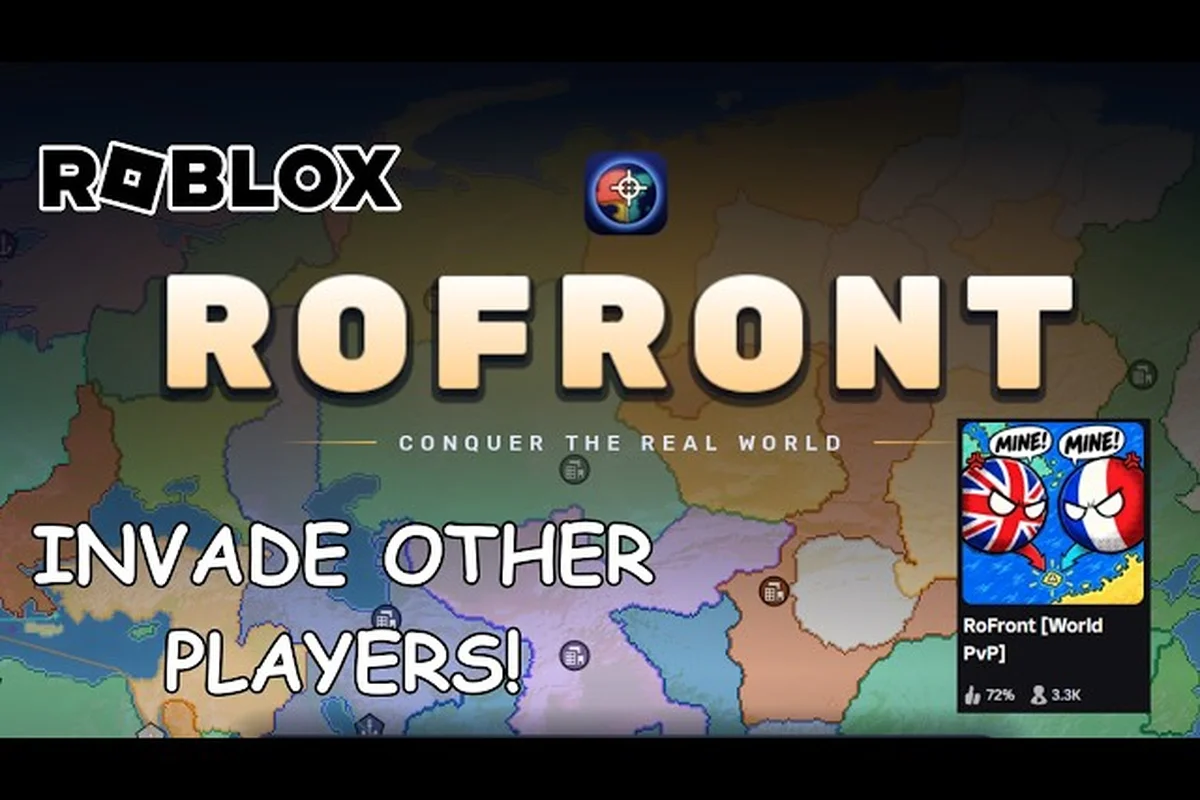
Winning a war in RoWorld depends less on throwing your entire army at one target than on controlling when, where, and how you commit. The official RoWorld page on Roblox describes a large strategic world with cities, ports, factories, alliances, and a control-based victory condition, so preparation and positioning matter alongside battlefield strength.
Why roWorld how to win a war requires more than troop count
A large army can lose its usefulness if production collapses, the front becomes too wide, or an opponent attacks while your troops are tied down. The central idea behind roWorld how to win a war is to create several advantages at once: a growing military economy, a credible threat at one border, and the freedom to respond at another.
The official listing says a match may include 88 player nations and hundreds of tribes, with up to 55 players in a server. It also lists 80% world control as the victory condition, although the page does not publish troop costs, attack ratios, income rates, or upkeep values. That means strategy should be based on observable decision patterns rather than invented numerical rules.
| Strategic condition | What it tells you | Better response |
|---|---|---|
| Strong production, weak position | Your army may be growing behind a vulnerable border | Secure a defensive buffer before attacking |
| Strong position, weak production | You can win a short fight but may not sustain it | Pause expansion and rebuild output |
| Broad frontage | Several enemies can pressure separate regions | Consolidate a central defensive position |
| Concentrated frontage | One mistake can expose several cities | Use layered defense and selective attacks |
| Enemy distraction elsewhere | Their army is committed against another target | Test one border, then reinforce where it succeeds |
A dependable military strategy therefore has three layers. First, keep enough production running to replace losses. Second, use geography to reduce the number of fronts you must guard. Third, strike only when the target is weak or when your local force has clear superiority. This approach helps you avoid the common mistake of treating every visible enemy troop as an immediate problem.
Building a roWorld troop advantage through production
Your roWorld troop advantage is not simply the number of units currently visible on the map. It also includes the rate at which you can replace losses, protect your production buildings, and move troops between threatened areas. A balanced force with secure logistics is often more valuable than a fragile mass that cannot recover.
Separate army size from military capacity
Community gameplay observations suggest a useful distinction between an army and a military system. The army is the force available for a particular engagement. The military system includes factories, cities, ports, routes, and the decisions that keep those forces supplied. The official page confirms cities, ports, and factories as features, but it does not define their exact effects or costs.
| Capability | What it contributes | How to develop it |
|---|---|---|
| Frontline strength | Forces capable of taking or holding ground | Concentrate units near the intended front |
| Replacement capacity | Ability to recover from losses | Protect factories and improve production access |
| Transfer capacity | Flexibility to answer a second front | Control routes between threatened regions |
| Strategic reserve | Forces for unexpected enemy moves | Keep part of the army outside immediate battle |
| Economic support | Resources that allow continued growth | Expand settlements without draining defense |
For roWorld military production, prioritize cities and factories that are safe from likely attacks before opening a distant front. Coastal or port access may also be strategically useful, but the official material does not explain transport rules, so treat route advantages as something to observe rather than assume.
Keep production resilient
Resilient production means that losing one settlement does not immediately end your ability to fight. Spread key infrastructure across more than one region when possible, and connect it with territory that you can defend. If your empire is only one city wide, every defensive mistake can affect both your front line and your future army.
A practical order of operations is: first stabilize military production and secure the capital’s income, then strengthen one forward settlement and its connecting route before committing to another nation’s territory. For example, if your capital supports one city but a newly captured province cannot yet replace its troop output, prioritize a defended route and a second production area rather than an exposed conquest. This sequencing preserves troop advantage, limits reinforcement travel time, and prevents the war from exposing multiple production weaknesses at once.
-
Secure the capital and nearby production before taking distant land.
-
Expand toward routes that reduce travel time between your cities and front lines.
-
Build a second production area so the army does not depend on a single vulnerable region.
-
Check exposed borders before committing troops to another nation’s territory.
-
Treat captured territory as useful only when it supports production, defense, or a safer route.
The roWorld economy mechanics overview can help you connect territory growth with the wider economic loop. Remember that the official page does not publish income rates, so compare your own results over time instead of relying on unsupported numbers.
Choosing roWorld attack timing without fixed formulas
There is no published timer that tells every player when to attack. Good roWorld attack timing comes from comparing the state of your force with the state of the target, then acting before your opponent can restore balance. The absence of official troop multipliers makes direct numerical prediction impossible, but there are still several clear signals to watch.
Use local pressure as the timing signal
The best time to attack is usually when your available force is stronger along the chosen route and the opponent has been forced to divide attention. Watch for three changes: their troops moving away from your border, their production area becoming exposed, or their attention shifting toward another player. Community videos repeatedly show players reacting to these movements rather than following a fixed countdown.
| Timing signal | Why it helps | Action |
|---|---|---|
| Enemy moves troops from your border | Local pressure may be falling | Prepare a limited probe or main attack |
| Enemy commits elsewhere | Their target may be overextended | Test a quieter route, then reinforce |
| Your replacement capacity rises | Losses become easier to absorb | Consider a sustained offensive |
| Your force is concentrated | Less exposure to a counterattack | Choose one clear axis of attack |
| Enemy is concentrated against you | Their formation may be committed | Look for an exposed side or isolated target |
| Your production is disrupted | Another offensive becomes risky | Stabilize before expanding the war |
Do not confuse activity with success. A flashing border may indicate an enemy probe, a full invasion, or a defensive redeployment. Confirm the direction and size of the movement before committing your main force. That check can be the difference between a useful attack and a war that consumes your army while another neighbor takes your cities.
Commit in two stages
A two-stage offensive gives you information before full commitment. Begin with the smallest force that can test the route, border, and enemy response. If that force reveals a favorable opening, reinforce with the main army. If the probe fails, pull it back before the enemy turns the engagement into a costly trap.
This method is especially useful against a player with several borders. It preserves the option to attack elsewhere and makes the enemy reveal which area they consider important. The purpose of the first stage is not to conquer territory; it is to buy clarity with limited exposure.
Applying roWorld military strategy to common war scenarios
A roWorld military strategy should change with the map, the opponent, and the condition of your empire. Treating every war as a frontal push is a common mistake because the official game world supports cities, ports, factories, alliances, and nuclear weapons. That feature set rewards positioning, coordination, and escalation control.
Attacking a stronger border
A stronger border should be tested rather than assaulted immediately. Secure nearby territory, improve your production access, and watch where the defender concentrates. If they respond quickly with a large force, redirect pressure and preserve your army. If they leave another sector thin, consider whether that weakness is temporary or the result of a broader strategic commitment.
Defending against a larger opponent
Defense is not a passive waiting game. Build depth behind the first contact area, protect cities and factories, and make each capture require more effort than your border can absorb. A narrow defensive focus can be effective when your replacement capacity is strong, but it fails if the enemy simply attacks elsewhere and forces you to choose which city to save.
For a broader view of holding ground, use the roWorld troop movement guide to examine deployment and border-defense decisions. Compare each front’s troop count, distance from your cities, and available replacement capacity before committing reinforcements: a static line may absorb an early probe, but shifting reserves between borders can leave one route exposed. Pair that analysis with military production and attack timing, because a wider deployment is ineffective if new units arrive after the enemy has already crossed the border or if factories cannot sustain the defensive cycle.
Fighting on several fronts
Multi-front pressure can be useful against an enemy, but it is dangerous for you if your production is already stretched. Pick one front as the main theater, use limited forces to discourage attacks on the others, and concentrate reinforcements where an enemy has actually committed. You do not need equal forces everywhere; you need credible resistance and a clear priority.
The roWorld allies and diplomacy guide adds another option: negotiate before dividing your attention. An ally that covers a distant border may be more valuable than a temporary territorial gain, although every agreement should be judged by how it affects your ability to respond independently.
| War situation | Primary goal | Main risk | Recommended response |
|---|---|---|---|
| Stronger enemy at one border | Prevent a favorable breakthrough | Overcommitting troops | Defend in depth and wait for a local opening |
| Enemy divided across the map | Create one favorable sector | Attacking the wrong target | Identify pressure shifts before reinforcing |
| Your production exposed | Preserve replacement capacity | Losing factories and cities | Retreat, rebuild, and protect the core |
| Several players attacking together | Consolidate defenses | Losing cohesion | Concentrate on the most immediate threat |
| Allied pressure complicates war | Preserve diplomatic flexibility | Trusting unstable coordination | Use clear agreements and avoid total dependence |
roWorld combat tips for attacking, defending, and recovering
Winning a war in roWorld requires more than landing a single attack. Effective combat tips should guide the entire operation: compare troop advantage before committing, time an assault when enemy troop production and resource income cannot quickly replace losses, and choose targets whose destruction reduces your opponent’s ability to reinforce. After a failed assault, retreat or redeploy rather than feeding troops into the same fight, then resume only when the front line and military production create a favorable opening. Knowing when to stop fighting protects your army from a costly, unwinnable escalation.
Pre-attack checks on forces and routes
-
Confirm that the target’s local forces are weaker, less organized, or focused elsewhere.
-
Check whether your route passes through vulnerable territory that an enemy can exploit.
-
Ensure that production remains active instead of converting every available resource into soldiers.
-
Choose whether the objective is land, a city, a factory, a port, or simply drawing the enemy away.
-
Keep a defensive force for an unrelated border because an opportunistic enemy may respond to your offensive.
During the attack
Concentrate your strongest available force around one crossing point or settlement. A dispersed army can look powerful on the map but struggle to create a breakthrough. If the enemy counters, do not continue feeding units into a losing engagement by reflex; withdraw, preserve the remaining force, and reassess production and position.
Naval and special-weapon features require even more caution. Nuclear weapons are confirmed by the official page, yet their costs, ranges, effects, and build conditions are not published. Treat them as escalation options rather than standard answers. Using a spectacular weapon at the wrong moment can disrupt your own plans, provoke retaliation, or divert attention from a more achievable objective.
After the attack
Success creates another decision: consolidate or expand. Occupying territory is not the same as securing it. If your captured area lacks a useful production role, connection route, or defensive value, it may add complexity without strengthening the war effort. A measured advance is often better than a rapid one.
After a defeat, avoid changing several parts of the strategy at once. First stabilize production and borders, then identify the cause: insufficient local force, poor timing, an exposed rear, or a lack of replacement capacity. The roWorld territory system guide can help separate territorial value from simple land count.
Turning military production into a durable winning cycle
The strongest roWorld military production cycle moves in a clear order: build protected income, maintain troops, threaten a border, commit only when favorable, then reinvest the result. This is a cycle rather than a one-time setup because every battle changes production, positioning, and enemy attention.
Use three planning horizons
| Planning horizon | Main question | Decisions to make |
|---|---|---|
| Immediate | Where is the enemy pressing now? | Reinforce, defend, or withdraw |
| Near term | Which front can we win next? | Select a target and time the attack |
| Long term | What empire do we want to build? | Expand toward secure production and defensible borders |
| Strategic | Who benefits if this war continues? | Avoid exhaustion and unwanted commitments |
A short-term victory can still be strategically poor. Capturing a city may create a new border that requires more troops to defend than the original target. Evaluate every gain by asking whether it improves your economy, strengthens your position, or removes an enemy threat. If it does none of those things, it may be costly vanity.
Measure progress without fake numbers
RoWorld does not publish official values for damage, upkeep, or income, so track conditions instead of invented percentages. Useful indicators include whether your cities remain secure, whether your production continued during the attack, whether you can shift troops between fronts, and whether the enemy recovered faster than expected.
| Result | Healthy sign | Warning sign | Corrective action |
|---|---|---|---|
| Offense | You gained useful territory or relieved pressure | Losses exceeded the strategic benefit | Stop and rebuild before another push |
| Defense | Enemy attacks were absorbed | Cities or factories became exposed | Deepen the border and protect production |
| Production | Replacement capacity supported the front | Military output fell during the war | Shift priorities from expansion to recovery |
| Diplomacy | Other players stayed focused elsewhere | Several enemies coordinated against you | Reduce commitments and repair relations |
This approach makes the guide applicable even when the game changes. The official Roblox listing was updated on October 26, 2026, and it is the best place to verify features or patch information that appears later. The official Torrey Pines community page is also the verified creator-group channel for announcements.
A complete war decision checklist
Use this checklist before major operations to keep the emotional urge to fight from overriding economic and geographic realities. Compare the expected payoff with the cost of deployment: a troop advantage can still fail if the target is far from your production base, and an early attack can leave your military production exposed. Check the attack timing, available troop count, movement time, supply capacity, and defensive strength before committing. If the route is long or the defender has enough time to reinforce, delay the operation and build up your forces instead.
Readiness
-
Production buildings and cities are secure.
-
At least one route connects the front with the military core.
-
The main enemy force is known to be weakened, committed, or mispositioned.
-
A second-front defense can operate without abandoning the main attack.
-
The objective is clear enough that success can be recognized.
Commitment
-
The first wave tests the route instead of consuming every reserve.
-
Reinforcements are committed in response to useful information.
-
Economic growth continues during the engagement.
-
Withdrawal remains possible if the attack meets prepared resistance.
-
A nuclear or other special escalation is reserved for a situation where it changes the broader war.
Consolidation
-
Captured territory has a defensible or economic purpose.
-
New borders are covered before another front opens.
-
Damaged production recovers before the next offensive.
-
Enemy alliances and responses are reassessed.
-
The campaign continues only if its gains strengthen the wider war strategy.
In short, roWorld how to win a war comes from disciplined timing: produce continuously, concentrate force, attack selectively, and preserve enough strength to handle the unexpected. A large army creates opportunity, but sustainable production and sound positioning decide whether that opportunity becomes victory.
Frequently Asked Questions
What is the best way to win a war in RoWorld?
The best approach is to protect your production, concentrate forces on one border, and attack when the target is locally weak or distracted. Keep a defensive reserve for another front, and reassess after every engagement. A war won on the battlefield can still fail if the offensive leaves cities exposed and destroys your replacement capacity.
How much troop advantage is needed to attack safely?
RoWorld does not publish official attack ratios, so there is no verified troop-count threshold. Compare the forces present at the target, the route you must cross, and the enemy’s ability to reinforce. A modest local advantage can work if it is combined with good timing, while a large global advantage can still fail if it is spread across unrelated fronts.
When should I attack another player in RoWorld?
Attack when the opponent has moved forces away, is focused on another enemy, or has exposed an important settlement or production area. Confirm the movement before committing your main army, then test with a limited wave. If the defense responds strongly, preserve your remaining troops and wait for a better change in position.
Should I expand during a war or focus only on defense?
Expand when the captured area strengthens your production, connects defensive positions, or removes a serious threat. Avoid expansion that creates distant borders while your main cities are under pressure. If losses are reducing your replacement capacity, stabilize first; otherwise, two difficult fronts can become more damaging than one carefully supported offensive.
Are nuclear weapons necessary to win a war in RoWorld?
No universal requirement is confirmed. Nuclear weapons are listed as a feature, but their costs, ranges, effects, and build requirements are not published. Treat them as an escalation tool rather than a mandatory opening move, because the timing, production impact, and retaliatory consequences are unclear in the official documentation.